Archive for January, 2010
Join us on our visit to South Africa!
Posted by editor on Saturday, 30 January 2010
The Garden House has arranged to take a group of gardening enthusiasts to South Africa in October. We are so looking forward to this trip! It will be South Africa’s spring season, when the Cape will be covered with field upon field of flowers in bloom.
Key aspects of the visit are highlighted below, for full details contact@gardenhousebrighton.co.uk
Arriving in Cape Town (South African Airways, direct flight from Heathrow), the group will stay at The Vineyard Hotel & Spa for four nights (www.vineyard.co.za a beautiful hotel set in its own glorious gardens).
Our first view of this amazing country will be from the top of Table Mountain (by cable car of course!), part of a half-day city orientation tour.
The next
day we take a guided visit to the Kirstenbosch National Botanical Gardens (www.sanbi.org), world-renowned for the beauty and diversity of the Cape flora it displays and for the magnificence of its setting against the eastern slopes of Table Mountain. This is the most beautiful time of year – when the whole garden is alive with colour as fields of Namaqualand annuals and spring bulbs burst into flower.
Whilst based in Cape Town we will also take a Winelands tour (tasting the local vintages of course!), and visit the Langa Township.
Our tour of Langa includes private gardens, and the inspiring community food gardens. The Abalimi Bezakhaya project teaches sustainable living, supplying locals with trees and shrubs to green their areas, and encouraging people to grow their own food.
We then leave the Cape travelling up the West Coast visiting Weylandts and the Tienie Versveld Wildflower Reserves, then on to the West Coast National Park and Postberg Nature Reserve – all the while taking in the stunning coastline and fields of wildflowers.
Our next base is Paternoster Lodge (www.paternoster-lodge.co.za). From here we visit Elandberg Eco Reserve for a Rooibos Tea Tour – with the added bonus of trying out a variety of refreshing Rooibos teas in the farm house, hosted by the farmer’s wife! We then drive on to Lutzville to meet Wynand, our specialist wildflower guide who will take us to his favourite flower spots, the Rock Art Trail, and show us around the wine estate at Matzikamma.
From there, on to the Aquila Private Game Reserve (www.aquilasafari.com) our base for the last two nights of our trip. Here we’ll enjoy an evening game drive, and the following day, a morning game drive – a fantastic opportunity to observe South Africa’s amazing wildlife up close.
So, just a brief summary of this exciting Garden House tour. Contact us for the full details contact@gardenhousebrighton.co.uk . All costs are included, bar a few meal times when you are free to wander and make your own local choices. We do hope you’ll be inspired to join us!
Prunus x subhirtella ‘Autumnalis’
Posted by editor on Saturday, 23 January 2010
Looking for a winter-flowering tree for your garden?
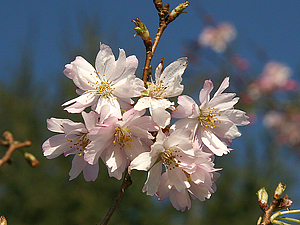
During the rather dreary months from late autumn to early spring there are a small number of woody plants that dare to flower and bring colour into the garden. The Autumn Cherry is one of them, Prunus x subhirtella ‘Autumnalis’.
Most of our winter-flowering trees are types of Prunus. From Japan and China, there were first talked about in the 18th century by the Swedish botanist Carl Thunberg, but it is only in the last 100 years that have become widely available in the West.
Prunus x subhirtella ‘Autumnalis’ forms a small, open-branched tree with a spreading canopy; and even when it is in full leaf it does not cast a lot of shade. It is a great choice for a small town garden. The flowers are small but delicate and they are semi-double, pink when in bud, opening to a creamy white which continue to open during mild spells until the end of March, which is amazing as the frilled flowers first appear in November. It is lovely for cutting and brining indoors.
Another added feature is that in autumn the leaves often turn a rich red and bronze. I prefer the white form but Prunus x subhirtella ‘Autumnalis Rosea’ has rose pink blossom while ‘Fukubana’ has the most colourful deep rose coloured flowers.
Be inspired by RHS Wisley…
Posted by editor on Friday, 22 January 2010
I was so pleased to read Elspeth’s Thompson’s article in last Sunday’s Telegraph (14 January www.telegraph.co.uk/gardening) extolling the joys of visiting RHS Wisley in the winter time, it chimes so perfectly with our planned visit on 13 February, when we are taking a group on a guided tour around the gardens.
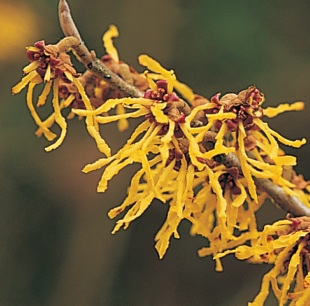
For her it’s the best time to visit, to appreciate the Piet Oudolf borders, plus the variety of winter flowering plants, especially the Hamamelis (witch hazels). We find it a great garden for inspiration for one’s own garden, particularly as all the plants are meticulously labelled.
Do join us if you can (check the Diary column for details). Driving there on one’s own can be rather gruelling along the M23 and M25, and so much easier in a coach!
Plant of the moment – Sarcococca
Posted by editor on Thursday, 21 January 2010
Sarcococca – common name, Christmas box or sweet box
What a plant – this evergreen shrub has so much going for it – it is evergreen, fragrant, graceful, good in shade, suitable for both containers or to grow in the garden border. It has one of the strongest scents in the winter garden and if planted on mass can be quite overpowering in a rather lovely sort of way!
The plant originates from western and central China, and is hardy, tolerating temperatures of -15C. It is happy in most soils, from acid to alkaline but does need a good feed to do well. It is ideal for leafy woodland. It will even tolerate deep shade although will cope in full sun as well, it becomes more open and lax in the shade. They will be fine in dry shade as well, even coping under conifers!
There are a variety of species to choose from, each bringing something special to the garden.
Sarcoccoca confusa is a neat evergreen bush that grows to about 1.2m high, and as much across. The white tassel-like flowers are arranged along the stem and these are followed by black berries, another added bonus.
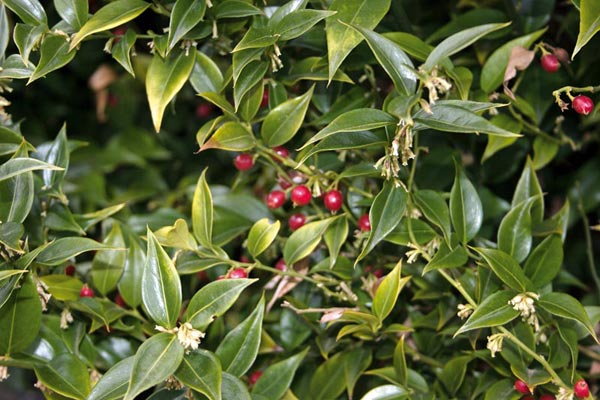
Sarcococca ruscifolia is similar but has thicker dark green leaves and produces red berries. This is a real beauty.
But best of all in my opinion is Sarcococca hookeriana var. digyma. Definitely worth learning the name! It has a suckering habit but is not invasive. It has narrow medium green leaves with reddish stems; its flowers are larger than the others, with pink on the backs of the petals, and has a fantastic scent. The cultivar ‘Purple Stem’ has particularly fine purples stems and leafstalks, and even the leaf midribs are flushed with purple.
Definitely a desert island plant for me!
Snowy gardenscape…
Posted by editor on Sunday, 10 January 2010
Pretty though the garden is under a layer of fresh snow, aren’t you just panicking about your plants?! Wondering whether they’ll recover, whether the border-line tender plants you never got around to protecting will survive – in fact wondering if you should get out there and do something about it!
Well the first thing we should do is look after the birds as they struggle to find food. Remember, these same birds will help you by eating grubs and insects when it’s warmer, so why not help them when it’s colder.
Fat balls and fat cakes are good for a range of birds. Seed mixes work well for blackbirds, starlings and sparrows, while peanuts and pieces of dried coconut will suit nearly all small birds in the garden in winter. Remember also that birds need water, so break the ice on your bird-bath or pour on hot water to defrost.
This winter we have watched as weeks of seemingly endless rainfall was followed by two bouts of snowy weather and heavy frosts. Now snow may seem bad but one small benefit is that snow acts as an insulator, protecting plants from the cold and frost.
Nonetheless some damage limitation is sensible. Brush off snow from the branches of large trees, shrubs and hedges.
By doing this you will help prevent them from becoming disfigured by the weight. Clear snow from the roofs of greenhouses or cold frames so that light can get through and so that the weight will not damage the structure.
Try not to walk on the grass. Walking on snow-covered grass can cause damage to the turf beneath and leave unsightly marks on the lawn, and can also encourage the growth of fungal diseases which thrive in the cool damp conditions.
Finally – just enjoy the sheer beauty of your snowy gardenscape – take some photos and make a note in your September diary to have your own Christmas cards printed!
By the way – these photos of The Garden House were taken by our friend, professional photographer Alex Stryczko!
Coming soon…Garden House events March-April 2010
Posted by editor on Wednesday, 6 January 2010
Plan ahead! Although some details are yet to be confirmed, here’s a quick taster of what’s to come in March and April 2010!
All workshops/talks include a light lunch/supper or nibbles, and coffee or a glass of wine!
March:
Saturday 6th – Monica Lucas, perennials expert; one-day workshop covering the identification and propagation of grasses. Cost: £40
Starting Tuesday 9th (then 16th and 23rd) – Mosaics with Sue Samways: a three-session course, learning techniques and creating a mosaic item. Cost: £100
Starting Wednesday 10th – How to be a Gardener; a 10-evening course designed to improve your gardening skills. Cost: £225
Saturday 13th – Hen keeping; one-day workshop, how to select and care for hens in an urban environment. Cost: £60
Saturday 20th – All About Pruning; popular one-day workshop covering when, what and how to prune. Cost: £65
Wednesday 24th – Sustainable living with the garden in mind; one-day workshop. Cost £60
Friday 26th – Ian Currie, weatherman; an evening talk about understanding the weather forecast. Cost: £15
Saturday 27th – Knitting for beginners; one-day workshop designed to teach the basics giving you confidence to embark on your own project. Cost: £50
April:
Tuesday 13th to Friday 16th – Spring School; our very popular four-day practical course, working and visiting a variety of horticultural settings. Cost: TBC
Saturday 24th – Staking and plants supports; one-day workshop covering essential and creative plant support techniques. Cost: £60
Courses and talks are led by speakers and specialists whose expertise we value, and who we know will inspire and inform. Look out for more details soon!