Archive for February, 2010

Visiting RHS Wisley with my father…

Posted by editor on Saturday, 27 February 2010

Having been on a visit to RHS Wisley last week with The Garden House I decided it was so amazing that I visited again this week, this time with my father (who is nearly 90) in tow.

RHS Wisley has such a wealth of information and this time – only a week later , there were different things to see and new plants emerging , despite the dreadful weather!

The alpines were certainly one of the stars of the show and they are a group of plants that I for one tend to forget about – an alpine is mainly grown between the tree line and the line of permanent snow and the conditions they have adapted to are many; altitude, cold, wind, free draining soil, poor soil and also a short growing season.

It is because of these conditions that they tend to be low growing and have leaves that have adapted to reduce moisture loss, so consequently the leaves are often small, rolled up, hairy or succulent.  Some are evergreens which reduces the amount of growth they have to make each season.

Alpines are associated with rockeries, this is an attempt to recreate their natural environment but Wisley have them growing in the alpine houses , this is so they keep dry.  They really dislike poorly drained soil and damp conditions.

RHS Wisley also has a wonderful educational value – the labelling is fantastic and seeing so many young children really enjoying themselves in the glasshouse was very hopeful – budding horticulturalists!

Do pay Wisley a visit – anytime of year there is so much to see – whatever your age!

Digging by Seamus Heaney

Posted by editor on Thursday, 25 February 2010

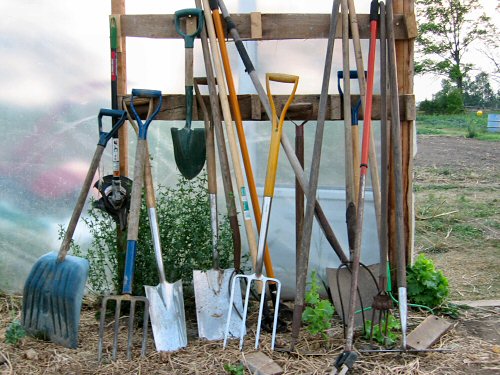
The weather is warming up and soon we will be able to get into our gardens and allotments. For some of us this will involve preparing new beds by digging – hard work but therapeutic.  I love this evocative poem by Seamus Heaney as he relishes the picture of his father digging.

Digging

Between my finger and my thumb
The squat pen rests; as snug as a gun.

Under my window a clean rasping sound
When the spade sinks into gravelly ground:
My father, digging. I look down

Till his straining rump among the flowerbeds
Bends low, comes up twenty years away

Stooping in rhythm through potato drills
Where he was digging.

The coarse boot nestled on the lug, the shaft
Against the inside knee was levered firmly.
He rooted out tall tops, buried the bright edge deep
To scatter new potatoes that we picked
Loving their cool hardness in our hands.

By God, the old man could handle a spade,
Just like his old man.

My grandfather could cut more turf in a day
Than any other man on Toner’s bog.
Once I carried him milk in a bottle
Corked sloppily with paper. He straightened up
To drink it, then fell to right away
Nicking and slicing neatly, heaving sods
Over his shoulder, digging down and down
For the good turf. Digging.

The cold smell of potato mold, the squelch and slap
Of soggy peat, the curt cuts of an edge
Through living roots awaken in my head.
But I’ve no spade to follow men like them.

Between my finger and my thumb
The squat pen rests.
I’ll dig with it.

Early spring at RHS Wisley…

Posted by editor on Saturday, 20 February 2010

We had a great visit to RHS Wisley last Saturday and were delighted with some very positive feedback from those of you who joined us.

“Thanks for a lovely trip.  You guys have a knack of making everyone feel so welcome…”

Wisley is the RHS’s flagship garden, and within its 200 acres it is possible to find plants suitable for almost every UK garden situation, irrespective of size, soil or location.  We focused on winter interest – whether in use of evergreens, coloured stems and barks, fragrance and winter flowering shrubs, perennials and bulbs.  It is always surprising how much beauty there is on a chilly, rather dull, February afternoon.  Being such a cold winter many of the plants were late in their display, so we would highly recommend a visit in the near future.

The Salix alba ‘Golden Ness’, Cornus alba ‘Sibirica’, Cornus sanguinea ‘Midwinter Fire’ welcomed us on arrival, and walking round the gardens we saw wonderful Hamamelis, and Lonicera x purpusii ‘Winter Beauty’, and lots of snowdrops.  It was bitterly cold and so to dive into the Glasshouse and spend time warming up while discovering this wonderfully tranquil paradise where exotic butterflies take flight among the plants was exceptional.  It certainly whetted our appetites for plants we may see in South Africa in October on our Garden House Tour.  Do join us! The tropical plants were extraordinary and we imagined what they will look like in their native surroundings.

Coming up: On April 17th we have organized a coach trip to Beth Chatto’s garden, details will be on the website soon; and on June 23rd we are visiting Mottisfont Abbey, where our main focus of interest will be the walled garden, home to their national collection of old-fashioned roses.

Snowdrop sale at Marchants Hardy Plants…

Posted by editor on Friday, 19 February 2010

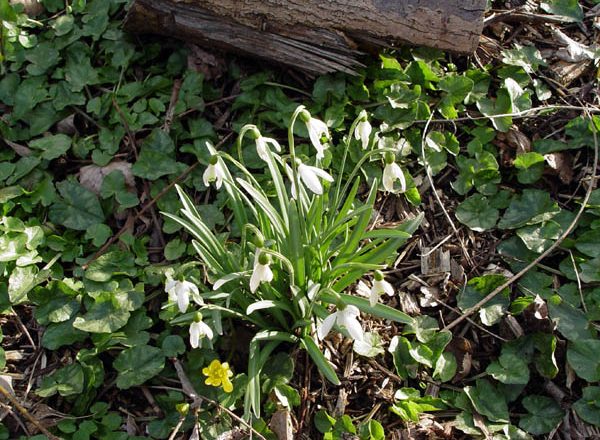
If you’re a Galanthus fan look no further.  Friday 19 and Saturday 20 February, one of our favourite nurseries, Marchants Hardy Plants, is holding a special sale of snowdrops, together with a cut flower display.

Many Galanthus species and hybrids and forms will be available – including the beautiful shaped G. allenii; G. x gracilis, Marchants own hybrid selection, with inner segments of solid deep green; G. ‘Bill Bishop’, a very large flowered and handsome snowdrop; G. ‘Jacquenetta’, the greenest of the doubles; and the more rare G. ‘Wrightson’s Double’, a unique, fat elwesii double (quite scarce and very beautiful).

However a number of the bulbs on sale are in short supply and will be sold on a first come first served basis.  Bulbs offered are best quality, and are believed to be true to name.

Plantsman and nursery owner Graham Gough writes:

“Snowdrops are not difficult to grow. In fact, it might be said that they are relatively easy provided a few rules of thumb are observed. They do not enjoy dense shade. Nor do they like stagnant, badly drained soil. Good drainage is therefore a must. Acid or lime soils seem to make little difference – we have seen them flourishing on both. That said, our own Snowdrops have relished growing on a thin chalk soil for many years which should be encouraging for those of you who happen to garden on this ‘hungry’ alkaline type soil. Dappled shade can also be advantageous though many Snowdrops will also prosper in full sun. As you may have gathered, they are really very amenable creatures and associate well with virtually all late winter and early spring flowering plants.

When the bulb you have purchased begins to increase and clump up (2/3 years), you can engage in the pleasure of increasing your stock by dividing the clump. (Clumps left to their own devices sometimes have a habit of ‘going back’ or dying out altogether). Division usually takes place in Feb/March when plants are ‘In the green’. This can be during or after flowering ( though most books will tell you to do it after). We have noticed little difference. Having gently teased the clump apart, it is important to plant at the same depth or perhaps a lttle deeper if the bulbs have risen to the surface, adding a little bone meal if you like to give your snowdrops a treat. On heavy soils the addition of sharp grit is efficacious. Any remaining nurture should be patiently left to Mother nature.”

Location: Marchants Hardy Plants, 2 Marchants Cottages,  Mill Lane,  Laughton,  East Sussex  BN8 6AJ / tel:  01323 811 737

Open: Friday 19 and Saturday 20 February / 10.00am – 5pm

Garden House visit to South Africa…

Posted by editor on Thursday, 18 February 2010

Join us on our visit to South Africa, 1-10 October 2010.  Spring – when the Cape is covered with field upon field of flowers in bloom – is a wonderful time for gardening enthusiasts to visit…

Key aspects of the visit are highlighted below, for full details: contact@gardenhousebrighton.co.uk

  • Ten-day trip
  • Direct flights to Cape Town (overnight)
  • Four nights at The Vineyard Hotel & Spa (www.vineyard.co.za a beautiful hotel set in its own glorious gardens)
  • One night at the Paternoster Lodge (www.paternoster-lodge.co.za)
  • One night staying at Clanwilliam, staying at St DuBarrys Guest House or Clanwilliam Lodge
  • Two nights at the Aquila Private Game Reserve (www.aquilasafari.com)

Travelling at all times with horticulture specialists, and an experienced and registered local guide.

We will also have a specialist field guide walking us through the Kirstenbosch Botanical Gardens.

Included:

  • Cape Town orientation tour – includes cable car to Table Top Mountain, District Six and Museum, Company Gardens
  • Peninsula tour – includes a guided tour of the stunning Kirstenbosch Botanical Gardens
  • Winelands tour – includes a visit to KWV Emporium for a cellar tour and tastings!
  • Community tour of the Cape Flats – visiting the community food gardens at Langa Township
  • Drive up the West Coast through Namaqualand’s amazing wildflower fields, to visit the West Coast National Park
  • Visit to Elandberg Eco Reserve for a Rooibos Tea Tour
  • Visit the Rock Art trails and the Wine Estate in the Matzikamma
  • Evening game drive at Aquila Private Game Reserve
  • Morning game drive at Aquila Private Game Reserve

Just a brief summary of this exciting Garden House tour, 1-10 October 2010.  Contact us for the full details contact@gardenhousebrighton.co.uk . All costs are included, bar a few meal times when you are free to wander and make your own local choices.

We do hope you’ll be inspired to join us!

Article image by Daan Loth - Image © DaanL aka Daan Loth 2009

We love Hippeastrum (Amaryllis)…

Posted by editor on Wednesday, 17 February 2010

Seeing Hippeastrum (Amaryllis) bulbs for sale at Wisley yesterday on our Garden House visit reminded us to tell you that it is not too later to enjoy these gorgeous, elegant, large flowered plants at home. Nowadays it is possible to find a great range, both in shape of flower and colour from white, pale pink to deep purple-reds, and oranges.

Quick Tips:

  • Planting Period: October until the end of April.
  • Flowering Period: Late December until the end of June.
  • Flowering time is 6 -10 weeks.
  • Larger bulbs produce more flowers.
  • Always store un-planted bulbs in a cool place
  • Submerge  roots and the base of the bulb in tepid water for several hours prior to planting

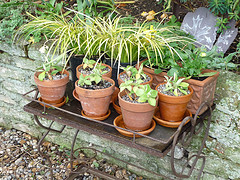
Amaryllis bulbs are huge, some up to 12 cm across, and they like a tight fit in their pot, soleave only about 2.5 cm between the bulb and the side, if planting only one. They thrive on being crowded. The pot should be twice the depth of the size of bulb.  I plant 3 or 5 (depending on size of bulb) in a Victorian wash bowl for maximum impact!

Amaryllis bulbs have a tendency to rot and drainage is vital so put a handful of crocks in the bottom of the pot.  Using a mix of multi-purpose compost and horticultural grit or perlite, plant the bulbs so that one-third of the bulb remains above the surface. Taking care not to damage the roots, press the soil down firmly to set the bulb securely in place. Water in well, although avoid watering the bulb itself as it is vulnerable.  Use tepid tap water. If like me you are using a bowl without holes in the bottom of it, you must water with great care so as to avoid water logging.

Regular checks need to be made on the moistness of the compost so it doesn’t dry out.  Once leaves start to appear you know that root activity has begun and the plants need regular watering.  You can also give a weak liquid feed every month to build up the bulb so you can enjoy its beauty next year.

As Amaryllis originate from South Africa a warm and sunny position, free from draughts, with a temperature of 15-20c, is ideal for good growth.  The plant should flower within six to eight weeks.  As soon as the flowers start to open, move the plant to a cooler place,   10-15c, to prolong their life.  Supporting the developing plants with a ring of twigs (birch or hazel) will both look beautiful, and prevent the tall stems from flopping. With the largest of the bulbs you should enjoy at least 3 consecutive flower stems.

When they are finished cut the old flower stems down to the base, leaving the foliage to continue photosynthesising in a warm and light situation. Continue watering and feeding until the leaves start to shrivel.  Stop watering and keep the bulb somewhere dry, cool and dark until the late autumn.

Shrove Tuesday – get flipping…!

Posted by editor on Tuesday, 16 February 2010

Just think – fresh eggs from your own hens, a great pancake mix, and a delicious filling – Shrove Tuesday heaven!

Well whilst we can’t supply you with the first (although of course, we’ll be enjoying the delicious eggs from our Garden House hens ourselves) – we can encourage you to join our Hen Keeping Workshop on Saturday 13 March – and we can suggest the recipe below!

  • 125g (4oz) plain white flour
  • pinch of salt
  • 1 egg
  • about 300ml (1/2 pint) milk
  • 15ml (1tbls) oil
  • oil for frying

1. Sift the flour and salt into a bowl and make a well in the centre.  Break the egg into the well and add a little of the milk.  Mix the liquid ingredients together, then gradually beat in the flour until smooth.

2. Beat in the oil and the remaining milk to obtain the consistency of thin cream (or use a blender). Ideally, if you have time, cover the batter and leave to stand in the refrigerator for about 20mins.

3. Heat a pancake pan (or shallow frying pan), when hot brush with the minimum of oil.  Add a little extra milk to the batter if it is thick.  Pour a small amount of batter into the pan and swirl around until it is evenly and thinly spread over the bottom of the pan.

4. Cook over a moderate to high heat for about 1min or until the edges are curling away from the pan and the underside os golden.  Flip the pancake over using a palette knife and cook the second side.

5. Turn the pancake out, fill, roll, and eat!

6. Lightly oil the pan between pancakes and do the same as above until all the mixture is gone.

Handy tip: You can freeze pancakes; once cooked turn out, allow to cool and place non-stick baking parchment in between each one.  bag, seal and freeze, then reove however many pancakes you would like to consume at your leisure!  they take seconds to defrost and can be reheated with ease in a microwave or pan.

Toppings: (the best bit…!)

  • Drizzle with freshly squeezed lemon juice and sprinkle with sugar  - or try lime juice for something different, perfect!
  • Place 2 scoops of vanilla ice cream on one side of the pancake, fold over and drizzle with fruit coulis, delicious!
  • Drizzle with maple syrup and roll up, irresistible!
  • Sliced banana and chocolate sauce, naughty!
  • Fill with berries (fresh, or defrost from frozen) – just add ice cream or cream to ensure you’re not being too healthy!

Enjoy…!

Haiti fundraiser at The Garden House…

Posted by editor on Monday, 15 February 2010

We’re delighted to report that last Friday’s ‘bring and buy a plant’ fundraising event was successful, raising £520 to support the UNICEF appeal for Haiti.

A huge thank you to all our stall-holders, to everyone who made delicious cakes to sell, to Starbucks who set up a stall and sold hot drinks, and to The Garden House crew who made delightful bird-feeders (all donating their takings to the appeal)…

Not to mention everyone who brought plants to sell, and all our friends and visitors who so enthusiastically did their bit, by turning up and buying!

Although out of the headline news, the desperate need continues – from the UNICEF website today:

Aid is getting through. Fifteen planeloads of UNICEF supplies have already landed in Port au Prince and Santa Domingo, with more on the way.

Life-saving supplies are being rushed into the hardest-hit communities in Haiti. So far these include oral rehydration salts to combat deadly diarrhoea episodes; water purifications tablets; medical kits; and tarpaulins and tents to provide temporary housing for thousands of affected children and families.

UNICEF globally has raised £80 million to carry out its immediate emergency operations in Haiti. This includes ensuring children and families have access to desperately needed clean water, providing therapeutic food for infants, reuniting unaccompanied children with their families and getting children back to school.

So, thanks again to everyone involved…

Shrubs for free – hardwood cuttings!

Posted by editor on Saturday, 13 February 2010

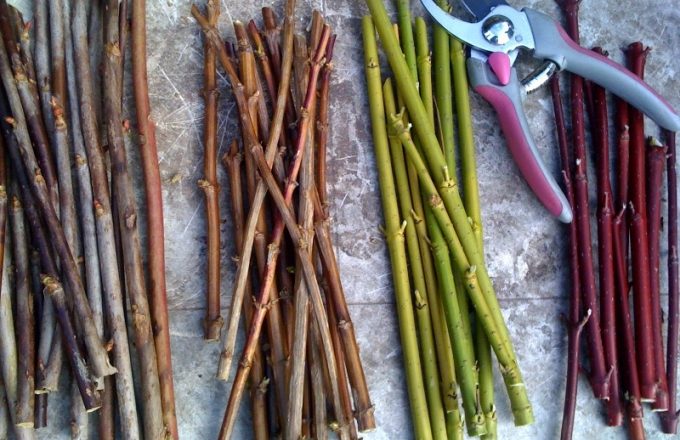
Now is just about the last opportunity you’ll have to take hardwood cuttings (it is preferable to start in November, but any time before the new spring leaves start to unfurl, is fine).

Today in The Garden House we were taking cuttings of Sambucus nigra, Cornus sanguinea ‘Midwinter Fire’, Salix alba and winter jasmine (Jasminum nudiflorum).   Any of the tougher shrubs work well, including forsythia, buddleia, euonymus, kerria, hydrangea, rosemary, yew, willow, dogwoods, weigela, berberis and pyrancantha.  Soft fruit bushes too, such as gooseberries, blackcurrants, redcurrants and whitecurrants – and some roses: Hybrid Teas, Floribundas, and certain shrub and patio roses.

So collect long straight stems, about pencil-width is ideal, and about 12-18” (30-45cms) long.  Make a clean straight cut directly below a leaf node and a sloping cut about 8-10” (20-25cms) above it, cutting just above a leaf node.  Snip off any small twiggy side-shoots.

You could dip the cutting into hormone rooting powder, but it’s not strictly necessary.

Plant your cuttings into ordinary garden soil or compost – either directly into a sheltered bed or border about 6” (15cms) apart, or into some fairly deep pots – plant deeply, so that only the top 1.5” (2.5cm) or so is left sticking out.  Firm in.

Come late summer, when the cuttings have grown 4-6” (10-15cms) shoots, nip the growing tips out, to encourage bushy growth.  Keep watered and leave undisturbed until this time next year, when you should dig them up and space out, or pot them up.  Give them another 6 months to a year before planting in their final position.

What better way than to grow your own shrubs as gifts, or for plant sales – it couldn’t be easier – this is also a great way to produce plants in bulk if you want to create a new hedge!


We love bees!

Posted by editor on Monday, 8 February 2010

On the last Saturday in January The Garden House hosted a talk by bee keeping expert Pam Hunter, a committee member of the BBKA (British Bee Keeping Assoc.) www.britishbee.org.uk.  It was certainly fascinating stuff, but be under no illusion – amateur beware!

Many of us have been seduced by the idea of bee keeping – we’re keen to aid sustainability and pollination, and we love the idea of collecting and bottling our own honey.  Also magazines are talking about bee keeping as a way of countering the decimating losses in honey bee populations caused by the Varroa mite and changes in weather patterns.

However those of us amateurs with romantic illusions of bringing rural bee keeping into the suburbs or inner city, were quite rightly challenged by Pam. Her view is that bee keeping has in some ways become a ‘fashion’ (a little like hen keeping), a hobby that gardeners are embarking on without realizing the commitment, experience and support needed, and in many cases without first thinking about the issues around safety (for your family, pets and neighbours).

Bees are not necessarily dangerous, but as Pam pointed out they are ‘wild’, we cannot contain them (swarming potentially is an issue), and they need to be treated with care and respect.

If you are seriously interested in keeping bees Pam recommends joining your local BBKA group, taking one of their in-depth courses, and using their knowledge and support before deciding.

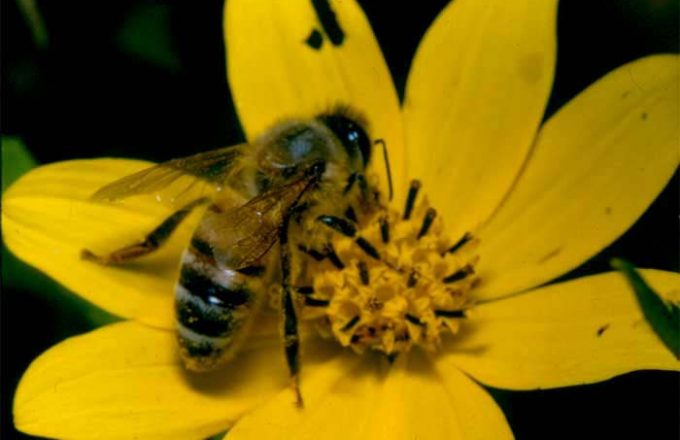
For most of us, the pleasure of encouraging bees into our gardens is enough. Bees depend entirely on plants, using scent and sight to identify pollen-rich flowers (they tend to prefer yellows and blue flowers). So fill your garden with bee-friendly plants and you’ll be doing your bit to sustain bee populations and encourage local honey production (honey bees fly up to 5 miles radius in search of food).

Bees prefer single flowers – double flowers are of little use, because they’re too elaborate. The single-flowered rose family, which includes crab apple, hawthorn and potentilla, seem to be irresistible to our buzzing friends, as are the flowers of fennel, angelica and cow parsley, and sedums. Tubular-shaped flowers, such as foxgloves, snapdragons, penstemons and heathers, are also favourite feeding places for bees.

Early flowering plants for bees:  Winter aconite, snowdrops, crocus, Daphne bholua, Hellebores, Clematis cirrhosa, Chimonanthus praecox, Sarcococca confusa, Mahonia, Hamamelis.

Spring flowering:  Bluebell, bugle, crab apple, daffodil, flowering cherry and currant, forget-me-not (Myosotis), hawthorn, hellebore (Helleborus corsicus, 
H. foetidus), pulmonaria, pussy willow, rhododendron, rosemary, viburnum, thrift (Armeria maritima).

Early summer flowering: Aquilegia, astilbe, campanula, comfrey, everlasting sweet pea (Lathyrus latifolius), fennel, foxglove, geranium, potentilla, snapdragon, stachys, teasel, thyme, verbascum.

Late summer flowering: Angelica, aster, buddleia, cardoon, cornflower (Centaurea), dahlia (single-flowered), delphinium, eryngium, fuchsia, globe thistle (Echinops), heather, ivy, lavender, penstemon, scabious, sedum, Verbena bonariensis.

One last comment from Pam – buy local honey whenever you get the chance – not only does it support local bee keepers, but it is hugely beneficial to our health!

Trees for small gardens…

Posted by editor on Saturday, 6 February 2010

Choosing a tree for a small garden takes a good deal of thought and planning. If you choose a tree that is too large it may need to be removed and this can be very expensive – it will also make growing other plants in the garden difficult as there will be competition for moisture, food and light.

It is possible to grow a tree in a container but this will restrict its overall height and spread and often spoil the eventual shape of the tree.

Selecting a tree:  Trees up to 8-10m (25-35ft) in height are usually reasonable for most small gardens, although in some cases a taller tree with a narrow habit may be better.  A narrow tree can give a more formal look with spreading trees offering shade.  If you only have room for one tree make sure you choose one that gives more than one season of interest – such as fruit, autumn colour and of course, flowers.

It may help you to draw a scale plan of your garden and then plot the size of your tree when it reaches maturity.  Don’t forget that if you are planting it in the corner of your garden that the canopy may shade your neighbour’s garden too.

Below are some suggestions for trees for small gardens.  Before making your choice make sure you check soil requirements and aspect (sun/shade/shelter from winds etc):

Acer palmaum ‘Sango-kaku’ – 6m

Amelanchier lamarckii – 10m

Cercis siliquastrum – 10m

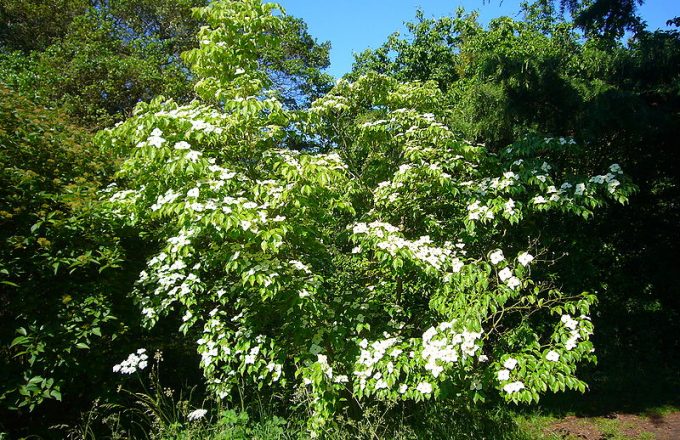
Cornus kousa var.chinensis – 7.5m (photo above)

Crataegus laevigata ‘Paul’s Scarlet’ – 8m

Malus ‘Evereste’ – 7m

Malus tschonoskii – 12m

Prunus  ‘Pandor’ – 10m

Sorbus hupehensis – 8m

All of the above trees have received the Royal Horticultural Society’s Award of Garden Merit (AGM).  This award indicates that the plant is recommended by the RHS.

With more than 100,000 plants available in the UK alone, the AGM is intended to be of practical value to the home gardener, helping gardeners to make the best and most appropriate choice. It is awarded therefore only to a plant that meets the following criteria:

  • It must be of outstanding excellence for ordinary garden decoration or use
  • It must be available
  • It must be of good constitution
  • It must not require highly specialist growing conditions or care
  • It must not be particularly susceptible to any pest or disease
  • It must not be subject to an unreasonable degree of reversion in its vegetative or floral characteristics

Trees add structure, contrasting height and beauty – key components of every successful garden design.  Even in the smallest garden, well-chosen trees offer seasonal interest, shelter – and a great place to hang your bird-feeders!

The Giant Carrot – children’s book

Posted by editor on Thursday, 4 February 2010

We just love it when we see children being inspired to garden and grow! Top of our current list of inspirational children’s ‘gardening’ books is The Giant Carrot, a collaboration between Allan Manham and Penny Dann.

Penny is a well-known and highly talented children’s illustrator – she also lives in Brighton, and happens to be a great friend of The Garden House!  You may recognise her name from her very successful Secret Fairy book series which sold over 1.5 million copies worldwide. www.pennydann.co.uk

Penny will be signing books, reading excerpts and doing the odd drawing if asked (definitely ask!) at the Book Nook in Hove on Saturday 13 February at 11am.

The Book Nook, First Avenue, 1 St Johns Place, Hove, BN3 2FJ / 01273 911 988 / www.booknookuk.com

The Giant Carrot is published by Orchard Books, and is also available to order on www.amazon.com.