Archive for April, 2010
Brighton Art Houses 1: Jo Sweeting, sculptor
Posted by editor on Thursday, 29 April 2010
If you’re not already a fan, the Brighton Artists Open Houses is a must – it is probably Britain’s biggest free visual arts event. It is. Over the first four weekends of May, a record 243 venues will open their doors to exhibit the work of over 1,000 artists and makers.
To celebrate and contribute to the event, we thought we would highlight a few of the local artists and sculptors whose work has a place in the garden, or who specialize in painting or creating plant forms.
Brighton-based sculptor Jo Sweeting is a particular favourite of ours. Her work is bold yet incredibly sensitive, and works so well in a garden setting.
Jo works mainly in British limestone, the subject matter often figurative or based on forms from the landscape, using words and poetry to highlight particular thoughts, events or celebrations. Her bowl forms are particularly striking. We also love her small pebbles, carved with hearts, feathers or letters.
Jo is showing at 28 Florence Road, Brighton – the home of Jo Riddells, and on the Beyond The Level trail (open all four weekends in May 11am-5pm). Definitely a ‘don’t miss’ art house!
Jo works and teaches at Skelton Workshops at Streat, near Ditchling. She also runs classes from her own lovely studio at 72 Ashford Road, Fiveways, Brighton
Just to note: On the weekend of 3/4 July Jo will be holding another Open House at 72 Ashford Road, exhibiting the work of eight local artists. Plus you’ll be able to see the newly designed garden created by Plantsman and designer Paul Bradford, with plants supplied by Miss Moles Emporium. See more of Jo’s work at www.josweetingsculpture.com
Check out all this years Artists Open Houses at www.aoh.org.uk
Question Time for Gardeners!
Posted by editor on Sunday, 25 April 2010
To introduce the annual Garden Gadabout, the organisers have put together a real treat – Question Time for Gardeners…
If you are wondering what to plant, considering growing your own vegetables or need to identify a pest or disease, then come along and join what promises to be a fun and enlightening evening. Thursday 13 May 7.30pm – 9.30pm.
The panel of horticultural experts is second to none:
- Graham Gough – who, supported by his partner Lucy Goffin, created the magical garden and nursery at Marchants Hardy Plants in Laughton, Sussex.
- Ed Ikin – head gardener at Nymans Garden and a strong advocate of biodynamics, planting according to the lunar calendar.
- Liz Dobbs – London-based gardening writer and editor of Gardens Monthly, whose books include Garden Makeovers and The Essential Garden.
- Julie Hollobone – is assistant editor of Gardens Monthly, a horticultural lecturer and author of an excellent book on propagation, Propagation Techniques.
- Robert Hill-Snook – head gardener at the Brighton Pavilion, and responsible for the restoration of the Regency gardens following organic and nature-assisted principles.
- Jim Miller – horticulturalist and lecturer at Brighton’s City College.
This event promises to be a great introduction to the Garden Gadabout – when, over two weekends in June/July, over 70 private gardens from Shoreham to Lewes and everywhere in between throw open their garden gates in aid of the Sussex Beacon charity. www.sussexbeacon.org.uk/gadabout
Box Office: 01273 736222 / Box Office Opening Times: Monday to Friday 10am – 5pm www.theoldmarket.co.uk
13 May 7.30pm – 9.30pm / £6.00 (£4.50 Concessions)
Location: The Old Market, Upper Market Street, Hove BN3 1AS
The Garden House Plant School
Posted by editor on Monday, 19 April 2010
We’re very excited to tell you about The Garden House Plant School. For the first time, we’ve created a course designed specifically to help you further develop your knowledge of plants and their families.
The course starts on Weds 9 June, and runs over six Wednesday evenings, from 6.30 to 9.00pm.
This will also be a very special opportunity to talk with the experts! We have invited plant experts Graham Gough, Julie Hollobone and Peter Thurman to each lead one of the evenings as guest speaker.
Julie Hollobone – is assistant editor of Gardens Monthly, a horticultural lecturer and author of an excellent book on propagation, Propagation Techniques. Julie will start the course by reminding us how plants work, investigating several different plants from a botanical point of view, and identifying their characteristics to aid classification into plant families.
Peter Thurman – is a horticultural and arboricultural expert, who has used his knowledge of plants to create thrilling borders and garden designs. Peter will be talking about ‘designing with plants and planting plans’. (note our lead photo of his stunning Betula/Cornus border!).
Graham Gough – supported by his partner Lucy Goffin, Graham created the magical garden and nursery at Marchants Hardy Plants in Laughton, Sussex. He is a great speaker and hugely knowledgeable, and will talk about plants he couldn’t survive without! That evening will be spent at his nursery, where we can see his ‘can’t live without’ plants in situ.
The course will also focus on selecting plants for the appropriate site – in Beth Chatto’s words finding “the right plant for the right place” – and on how to use colour to its best advantage in the garden.
And finally there will be a session of exchanging information about plant families where each participant, having home-studied a plant family in depth, will share their knowledge with the group.
The course starts Weds 9 June and runs for a total of six weeks. The cost is £280 to include a light supper and glass of wine on each of the evenings.
This very special course is limited to eight people only, so please do book early. For more details and booking form, go to DIARY on this website.
Iced Gem heaven…
Posted by editor on Friday, 16 April 2010
If you or yours are in celebratory mood and in need of a fabulous garden-related cake (or any other theme) – look no further…
Recently, Brighton-based pastry chef and cake decorator Gemma Macfarlane made a cake to celebrate Bridgette’s dad’s 90th birthday – the wheelbarrow cake in the picture, piled high with vegetables! We think Gemma’s work is quite extraordinary and want to spread the word…
Her website www.icedgemcakes.co.uk has photos of the many celebration and wedding cakes she’s designed – including a incredibly delicate and intricate rendition of the West Pier for Lord Richard Attenborough’s 80th birthday.
Gemma also specialises in gluten, wheat and dairy free baking. “Many people think having special dietary requirements means they have to give up their favourite foods, but that needn’t be the case. I’ve spent years researching ingredients and creating recipes that anyone can follow to make their own delicious cakes, pastries and treats.”
Her other website www.icedgembakes.co.uk is full of free recipes, hints and tips to make great tasting wheat, gluten and dairy free cakes and desserts. You can also buy Gemma’s recipe book online – it comes in eBook or paperback versions.
So – inspiring, delicious and good for you – what could be better? I can’t wait until my family’s next big event!
Sowing seeds: Part 2
Posted by editor on Wednesday, 14 April 2010
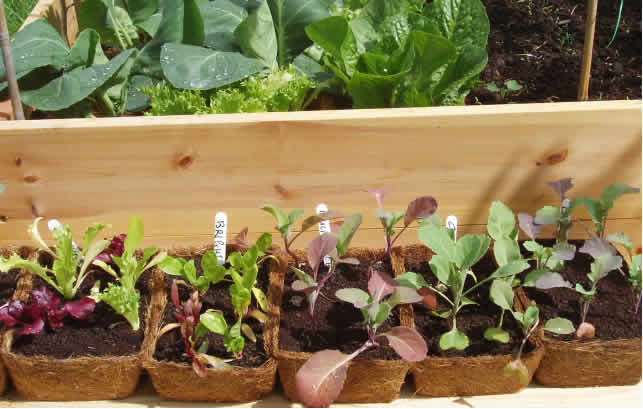
Pricking out seedlings, hardening off and sowing outdoors. There’s still time to sow more half-hardy annuals and vegetables. If you haven’t already, sow under glass courgettes, marrows, pumpkins, sweetcorn and greenhouse cucumbers. Outdoors, sow beetroot and turnips, peas and broad beans, broccoli, cabbage, carrots and chard amongst others. Continue to sow lettuce and salad leaves.
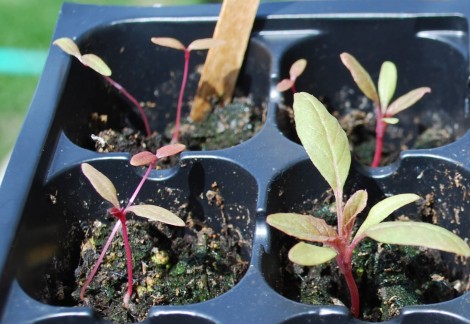
Seeds sown a few weeks ago should be sprouting now and ready for pricking out.
- Fill a seed tray with moist John Innes No 1 potting compost or similar.
- Firm the soil then mark out planting holes with a pencil or dibber, approx 1-1-1/2” (2.5-3.5cms) apart each way.
- Gently ease out a small clump of seedlings, with some of their compost (a small plastic plant label is ideal for this delicate task). Hold each seedling by one of its leaves and tease it away from the others (never handle by the stem).
- Lower the individual seedlings into their planting holes and firm the compost around each. Take care not to damage the roots.
- Label, then water with a fine mist sprayer. Place out of direct sunlight for a day or two, then move into the light. Keep the compost moist, but not wet.
Once established – four to eight weeks after pricking out – harden off young plants.
- Move the tray or pot to a sheltered spot outdoors in fine weather, bringing back indoors at night.
- After a week or so, leave outside permanently, but protect from harsh weather and shelter at night.
- A cold frame is an ideal place to harden off young plants. For the first few days, open the frame slightly, during the day only. Increase ventilation gradually, until by late spring the cold frame is completely open.
All hardy annuals and most half-hardy annuals can be sown directly outdoors.
- Prepare the soil: In autumn, work in some compost or well-rotted manure. Come spring, as soon as the soil is reasonably dry, break up the soil further, sprinkle in a good general-purpose fertilizer, then rake thoroughly creating a fine, crumbly tilth.
- In dry weather moisten the soil a day or two before sowing, then again two or three days after sowing.
- Sowing in drills: Make shallow drills approx 1-1.5cms deep (for planting distances check the seed packet carefully). Sow thinly to avoid too much thinning later. Cover seeds by running the tip of the hoe along the ridge of the drill, then tamp down to lightly firm the soil.
- Once seedlings appear, start to thin out the weaker seedlings.
- Sowing in borders: Prepare a sketch plan of your desired layout, and mark out the sowing areas with a trail of sand or the edge of a hoe.
- Scatter seeds over the area, then rake over gently.
- As with sowing in drills, water the area in advance then again a few days after sowing if the weather remains very dry.
The Garden House sells many hardy and half-hardy seeds – see SHOP on this website for more details. Our seed packets are beautifully illustrated by Brighton illustrator Vicky Sharman – see PICTURES on this website to view the individual seed packets.
Sowing seeds: Part 1
Posted by editor on Thursday, 8 April 2010
Simple, affordable and productive – now is the time to get seed sowing! The only successful means of propagating annual plants is from seed. Most perennials also grow well from seed, however cuttings or division are usually quicker methods of growing these plants.
At The Garden House our favourite annuals are those we come back to time and time again – that we love for their special colour or variety, and that are good easy performers.
Hardy annuals – amongst others consider Ammi majus, Cornflower Black Ball, Cerinthe major ‘Purpurascens’, Eschscholzia californica, Marigold Indian Prince, Nigella damascena ‘Miss Jekyll’ and Sweet Pea Matucana – these do not need heat, so a cold greenhouse is fine.
You can also sow Verbena bonariensis and Nicotiana mutabilis Marshmallow now, but only if you have a propagator or heated greenhouse as these need heat to germinate.
Half hardy annuals – like Cleome Helen Campbell, Sunflower Earthwalker, Cosmos Sensation Mixed, Erigeron karvinskianus and Zinnia Envy can also be sown now until early May.
And don’t forget salad seeds – fast growing and ideal for sowing every fortnight are Lettuce Freckles, Lettuce Marvel of Four Seasons, Lettuce Red Salad Bowl…
Raise seedlings indoors:
By sowing under cover in a cold greenhouse or on a warm window-sill, plants can be brought to flower a few weeks earlier.
- Scrub out your pots and seed trays and rinse thoroughly
- Use specially formulated seed compost (never use potting composts which contain fertilizer that might burn delicate seedling roots

- Sow seeds thinly over the surface – generally sow seeds at a depth equal to their thickness – very small seeds need only a fine covering of soil, larger seeds can be planted deeper
- Very small seeds can be mixed with a little sand before sowing – this makes them easier to see and spread evenly
- Sweet peas prefer minimal disturbance so we sow seeds singly in cardboard toilet roll ‘pots’ – once germinated and 4-5” tall, they can be planted outdoors in their toilet rolls – these soon disintegrate
- Water the compost from below, standing the tray in water until the surface of the compost appears wet, then remove the tray
- Don’t forget to label your seeds!
- Cover with glass or polythene (wipe daily to remove condensation), or newspaper (for warmth without the condensation)
- Stand container in a warm place (possibly an airing cupboard) checking daily until the first seed leaves appear, then remove the cover and move container into the light, maybe on a bright window-sill
- As soon as the first true leaves have developed, the seedlings are ready for pricking out
In a few days time, look out for our Sowing Seeds: Part 2 – pricking out seedlings, hardening off and sowing outdoors.
For certainty, buy your seeds from reputable suppliers – for fun, swop seeds with friends or use the seeds you salvaged dry from your plants last autumn.
The Garden House sells packets of all the above seeds, and many more – see SHOP on this website for more details. Our seed packets are beautifully illustrated by Brighton illustrator and Garden House friend Vicky Sharman – see PICTURES on this website to view the individual seed packets.
Helen Dillon’s radical philosophy…
Posted by editor on Friday, 2 April 2010
“Dig it up and throw it away” was the title of a talk given by the much-admired gardener Helen Dillon at last Sunday’s Hardy Plant Society (Sussex Group) meeting.
Drawing on over thirty-five years’ experience in her Dublin garden, Helen amused the audience greatly with her tales of plants that simply wouldn’t behave as she wanted or perform as she wished! “Love, nurture, let go” is her philosophy.
Her illustrated talk encompassed many aspects of gardening that ring true for us all. She is a most impressive plantswoman, yet she also completely understands the issues, angst and frustrations we experience in our own gardens.
Helen’s ideas could be considered a little left field (we love that!). Refreshingly she’s all for rethinking the expected, happy to make room for new ideas…
- Having grown tired of the huge box balls cornering her borders, Helen boldly sliced off the tops like boiled eggs and scooped out the centres – creating box bowls instead.
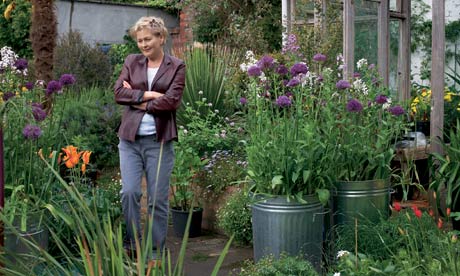
- Helen uses dustbins to great effect – filled with tulips, cannas and verbenas, or runner beans!
- She ties her plant labels to the looped ends of wire coat-hangers – a great idea, we loved that one.
Helen talked of some of her favourite plants – Bengal Crimson Rose (R. chinensis var. sanguinea), Isoplexis sceptrum (a spectacular evergreen shrub, native to Madeira), Bergenia purpurascens (“the only plant I ever stole” she told us) – amongst many many others.
We’re currently re-reading Helen Dillon’s GARDEN Book (ISBN: 978-0-7112-2710-1). It’s so typically Helen, a book divided into thoughts rather than chapters – Sitting in the garden, Why did it die?, Plants worth searching for, Hiding the neighbours, Scent, Burglar-proof plants – and so on. Delightful.
NOTE: At The Garden House we are great fans of The Hardy Plant Society – it exists to inform and encourage the novice gardener, stimulate and enlighten the more knowledgeable, and entertain and enthuse all gardeners bonded by a love for, and an interest in, hardy perennial plants. If you are interested in finding out more visit www.hardy-plant.org.uk/