Archive for May, 2010

Chelsea Flower Show favourites – glorious Irises!

Posted by editor on Saturday, 29 May 2010

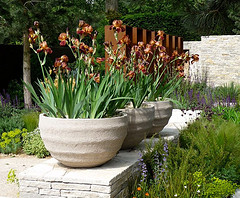
Brighton-based designer Andy Sturgeon won both gold and Best in Show Garden at CFS with his contemporary gravel garden. A wonderful and adventurous garden in many respects – the free-standing rusted steel structures framing stunning planting.  Our eyes were particularly drawn to three large dramatic bowls of bronze coloured irises (Iris ‘Action Front’).

We also loved the stunning display put on by Cayeux, the French Iris specialists. The logistics of exhibiting at Chelsea Flower Show were quite a challenge for Cayeux – their nursery in France has no poly tunnels, all irises being grown in 55 acres of open fields. Thus the plants shown at Chelsea were grown in England by the nursery Iris of Sissinghurst, in pots from rhizomes sent over in August 2009 from the Cayeux fields in France. www.iris-cayeux.com

Irises are well suited to dry, hot conditions.  The following planting/care info is taken from the Cayeux website:

  • When to plant: July to mid-October. It is important that the roots of newly planted Irises are well established before winter.
  • Where to plant: In full sun – 
Irises need sun at least two thirds of the day. The soil must have very good drainage. Plant either on a slope or in raised beds. No water should be allowed to stand in iris beds.
  • Soil preparation: If your soil is heavy, coarse sand or humus may be added to improve drainage. Lime is also good to improve clay soils. The ideal pH is 7 (neutral), but irises are tolerant in this regard. Remove all the weeds before planting.
  • Distance apart: Plant 30 to 40 cm apart. Closer planting will give an immediate effect, but the irises will need to be thinned often.
  • Depth to plant: Irises must be planted so that the tops of the rhizomes are exposed and the roots are spread out facing downward in the soil. Just after planting, water to pack down the soil around the roots.
  • Watering: Newly set plants need moisture to help their root system become established. Once established, irises do not need to be watered except in arid areas and it is always better to under-water than over-water.
TOO MUCH WATER CAN INDUCE ROT.
  • Dividing old clumps: Irises must be divided every 3 to 5 years before they become overcrowded and begin to flower less. Thin by removing the old divisions at the centre of the clumps and leaving new growth in the ground. Alternatively, dig up the entire clump and remove and replant the big new rhizomes.
  • Feeding: Depends on your soil type but bone meal, superphosphate or 5-10-15, or 6-8-12 are effective. Feed once in early spring and then one month after flowering.
AVOID USING FERTILIZERS HIGH IN NITROGEN, IT ENCOURAGES ROT PROBLEMS.
  • About the foliage: During the growing season healthy green leaves should be left undisturbed, but diseased or brown leaves must be removed. In the late autumn, trim off old dying foliage and cut the leaves back to about 15 cm. Flower stems should be cut off close to the ground after blooming.

Particular Peonies: Paeonia mlokosewitschii

Posted by editor on Monday, 24 May 2010

This excerpt from the late Geoffrey Smith’s Easy Plants for Difficult Places (David & Charles 1967) is featured in Garden Wisdom by Leslie Geddes-Brown, a wonderful compilation of writings by many of Britain’s best admired and loved garden professionals:

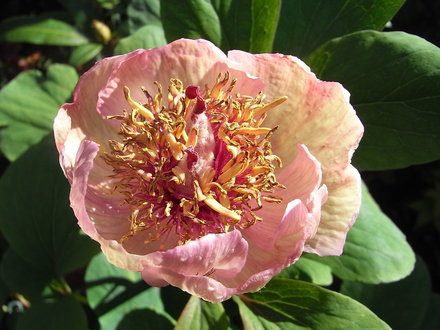
“Of all this beautiful genus, Paeonia mlokosewitschii is my particular favourite.  Not only is it the first to flower in this garden, but from the glaucous-green leaves to the primrose-yellow flowers, 5-6″ across, it is a breathtaking sight when in full bloom.  Compared to the species already described this is a dwarf, only 15-18″ high.  The flowers appear in May, rather than later in other more sheltered gardens. Propagation, as with other species, is by seed.  A word of warning when sowing seed of any peony, make certain the mice cannot gain access to them or nothing will be left but empty husks.”

Geoffrey Smith (1928-2009)

Inspirational garden: Houghton Lodge

Posted by editor on Thursday, 20 May 2010

Visit the delightful Houghton Lodge gardens with The Garden House!  On Wednesday 23 June we’ve a great day planned – visiting Mottisfont Abbey to see the collection of old-fashioned roses, and Houghton Lodge to see the inspirational garden.

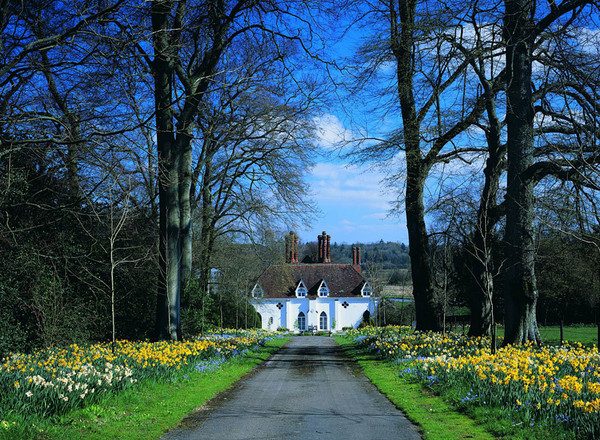
Houghton Lodge is undoubtedly one of the most beautiful privately owned houses and gardens in Hampshire. The house is a picturesque late 18th Century Grade 2 listed gothic cottage orné, idyllically set above the tranquil waters of the River Test.  It is set in extensive grounds, with fine trees and lawns sweeping down to the banks of the river.

The garden is described by Tamsin Westhorpe, editor of The English Garden as “one of the most romantic gardens I have ever experienced” and offers a myriad of charms as inspiration for the gardener.  There is a fully restored chalk cob walled kitchen garden with greenhouses run on hydroponic principles (thus using less water and space) – also a long herbaceous border, orchid house, topiary parterre and a lovely wildflower meadow leading down to the river.

In late June the roses and peonies will both be in full blossom and should be looking wonderful. www.houghtonlodge.co.uk

For more information on this delightful visit, or to book, go to DIARY on this website.

Happy knitting with The Garden House!

Posted by editor on Tuesday, 18 May 2010

Here at The Garden House we love knitting! Which is why we’re running two great workshops in July, led by expert knitter Julia Hincks – Knitting Workshop 1: Cable and Texture on 6 July, and Knitting Workshop 2: Colour on 13 July.

Join these fun and friendly workshops, designed to give you the confidence to complete your own knitting project. Bring your ideas, pictures or creative project. If you have needles, yarns or patterns bring them along too – but don’t worry if not, we’ll have plenty here for you to use.

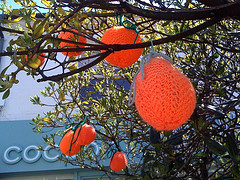
How about knitting a textural picture or cushion? Or what about some 3D flowers or fruit? One of our favourite knitting shops is Cocoon on George St, Hove – outside the shop is a small tree hung with bright orange knitted fruit!  What fun, we love it…!

Check our DIARY on this website for more details. *SPECIAL OFFER – if you book both workshops together – there’s a special discount price of £50 for the two!

Brighton Art Houses 4: Dan Bennett

Posted by editor on Saturday, 15 May 2010

Dan Bennett, painter and print-maker, is showing at Studio 106, an artists’ collective based in a converted warehouse in the Poet’s Corner district of Hove.

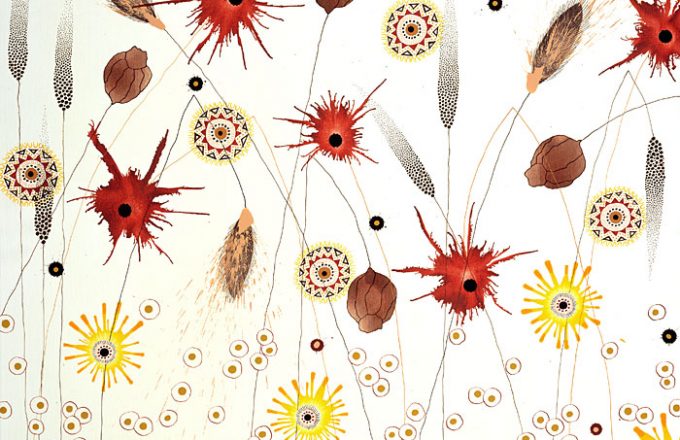
Reflecting his love of gardens, Dan’s work beautifully expresses the colour, textures and form of groups and individual plants. This, combined with his respect for the pattern making of the Aborigine and of other indigenous global cultures, gives his work a unique and unexpected quality. www.dan-bennett.co.uk

Abstracted plant forms that sway and move before the eyes, vibrant colour that literally bursts from the canvas – we love the intensity of his work.

At this year’s Open Houses Dan will also be exhibiting his rock paintings for the first time:  “My art practice is currently undergoing a transition. Although I am still deeply inspired by the prehistoric symbols that can be found etched onto rocks by our global ancestors, I have recently become as interested in the rock itself. This interest expresses itself as a desire to climb and paint these ancient structures so as to better understand them. I have found that by physically moving across their surfaces I have gained a deeper intuitive knowledge about the world in general, in a similar way in which painting helps me understand the world. The mechanics of forces, levers, tension and friction which are involved in rock climbing have led to moments of inspiration which I am currently pursuing in my painting.”

There’s still time to catch Dan’s exhibition – Sunday 16 and the following weekend 22/23 May. Open from 11am to 5pm,  Studio 106 is located at 106 Coleridge Street, Hove, BN3 5AA. www.studio106.co.uk

Brighton Art Houses 3: Lindy Craig-Hall

Posted by editor on Saturday, 8 May 2010

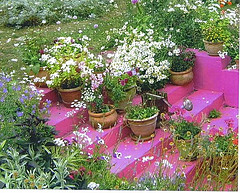
Visit Lindy’s house at 31 Preston Park Avenue, Brighton, and enjoy the work of several artists creating decorative and functional outdoor artwork and sculpture. Lindy’s house is an artwork in itself – an inspiring tapestry of colour, pattern, decorative home accessories and antique chinaware – even her garden steps are painted brilliant fuschia pink!

Amongst a group of textile artists, ceramicists, painters, mosaicists and jewellers, Lindy also shows the work of several artists whose work adorns the outside space.  Chris Murphy makes ceramic bird houses, feeders and ornamental garden conicals, Jo Brook makes ceramic garden pots and birdbaths, and Sue Samways makes mosaic lawn dials and garden tables.

Decorative garden ironwork is made by Steven Betridge (wonderful for clambering Clematis), and deckchairs customized with patchworked fabrics are made by Lindy Craig-Hall herself (wonderful for lounging!).

Special note: Jewellery-maker Val Shore is also showing at Lindy’s – Val will be leading a jewellery-making workshop at The Garden House on the evening of 14 June.  Check the DIARY on this website for details.

Address: Lindy Craig-Hall, 31 Preston Park Avenue, Brighton, East Sussex BN1 6HG

Open: Weekends of 8 & 9 May, 15 & 16 May and 22 & 23 May (11am to 5pm).

Brighton Art Houses 2: Frances Doherty, ceramicist

Posted by editor on Wednesday, 5 May 2010

You know how sometimes you look intensely at a flower and just can’t believe the colours are ‘made by nature’?  Few artists so completely capture the depth and vibrancy of natural plant forms as successfully as Frances Doherty.

Frances is the second artist to be featured in our celebration of local creators whose work captures the beauty of plant- or garden-related subjects.  We love her observational style and ability to capture and exaggerate the sculptural forms of seed-heads, pods and fruiting bodies.

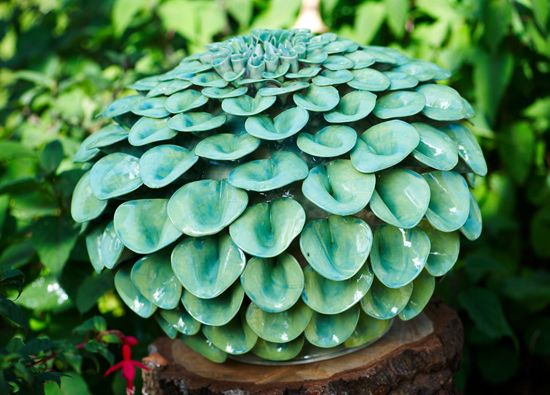
Working in stoneware, Frances uses richly iridescent glazes chosen to compliment the form, making the pieces glow with colour.  Her work is high fired so that the pieces can go into an interior or exterior environment.

“My inspiration comes from flowers and plants that we see all around us, in gardens, fields, even cracks in the pavement. I particularly love the secret worlds inside these flowers, in the patterns and textures hidden away that give a continuing sense of promise and renewal.”

The images shown here were taken at the Life Cycle Sculpture Trail at the Ventnor Botanic Gardens, Isle of Wight, during summer 2009.

As part of the Brighton Open Artists Houses festival Frances will be exhibiting at 31 Havelock Road,
Brighton, part of the Five Ways Artists Group. www.fivewaysartists.com

During the festival, Frances will also be showing some of her sculpture in the front gardens of Havelock Road, starting from Mrs Moles Flower Emporium and then going up Havelock Road at numbers, 13,14,18,29,31 and 64.

See more of Frances’s work at www.francesdoherty.co.uk

Check out all this years Artists Open Houses at www.aoh.org.uk

A Little Budding Rose…

Posted by editor on Sunday, 2 May 2010

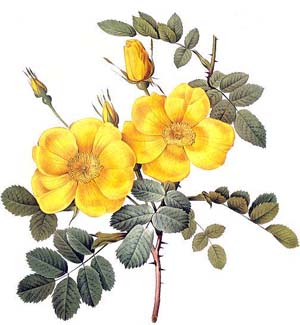
Roses have a long and colourful history – from the early damask rose, to the old-fashioned China roses, to the modern shrub – and now this much-loved plant is increasingly being used in more contemporary settings. Versatile and easy to grow, they come in many different types, in every size and shape, and are suitable for almost any aspect and situation.  They look wonderful scrambling over arches and clothing walls, work as ground cover around shrubs, and as focal points in containers – we could all find a place in our gardens for a rose (or two!).

A Little Budding Rose

It was a little budding rose,
Round like a fairy globe,
And shyly did its leaves unclose
Hid in their mossy robe,
But sweet was the slight and spicy smell
It breathed from its heart invisible.

…by Emily Bronte

If you’re a lover of roses, or a beginner wanting to know more about this fascinating species, join us here at The Garden House on Saturday 05 June for our workshop All About Roses with Simon White.  Simon, an expert from the Peter Beales specialist rose nursery in Norfolk, will give an in-depth illustrated talk, plus demonstrations on caring for roses.

Continuing the rose theme we are visiting Mottisfont Abbey to enjoy their national collection of roses on Wednesday 23 June.   Why not join us for both?  See the DIARY on this website for more information.