Archive for November, 2010

Great Dixter; winter inspiration

Posted by editor on Tuesday, 30 November 2010

“If Dixter always remains loved and retains its own identity, everything else will fall into place.” Christopher Lloyd, January 2006

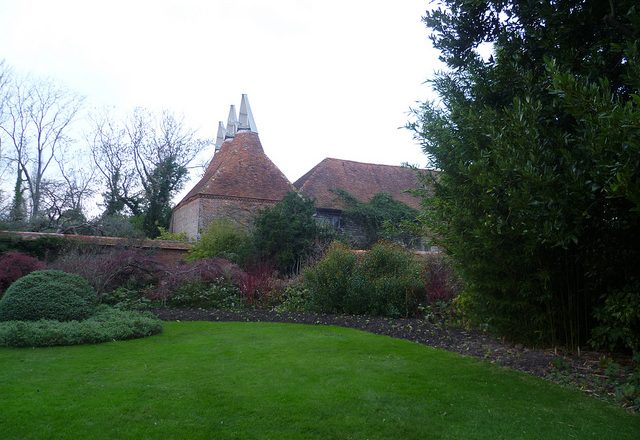
If you are a gardener then you absolutely must visit Great Dixter, near Rye, East Sussex.  I was lucky enough to go there yesterday for the Christmas Fair (27/28th Nov only).

The incredible spirit of this wonderful garden still lives on and is a testament to the words of the great horticulturalist Christopher Lloyd who lived and gardened at Great Dixter all his life, leaving the estate to The Great Dixter Trust on his death in 2006.

Great Dixter is a Tudor house bought in 1910 by Nathaniel Lloyd, father of Christopher and author of books on brickwork and topiary, and was restored by Edwin Lutyens. Nathaniel designed the framework of the garden and it was initially planted by Daisy Lloyd, Christopher’s mother, who taught Christopher how to garden.

The house is surrounded by the now world-famous garden that was Christopher Lloyd’s lifelong passion; his influence since the war on amateur gardeners in this country can scarcely be overestimated.   He had an encyclopaedic knowledge of plants, together with a love of form and colour – and together with his great strength of trying something new Great Dixter was always evolving, always fresh.

In 1996 he became bored with his rose garden, which had been designed by Sir Edwin Lutyens and established for more than 70 years, he simply uprooted it. The replacement, a brazen kaleidoscope of sub-tropical plants, sent shock waves through the gardening world.

It is the most inspirational garden, clearly loved and still gardened by Fergus Garrett who was Christopher Lloyd’s head gardener, and who continues as the garden’s creative head.

Yesterday on a cold November day the late autumn structure was astonishing – the yew hedges and topiary, grasses, trees and shrubs looking beautiful in the low November light.

The fires burning in the grates were welcoming – doubtless the timber in the great hall could tell a thousand stories, Christopher Lloyd was alive today I think he would have been delighted to see his extraordinary home filled with people having fun and enjoying the spirit of Great Dixter.

For a great read try: Colour for Adventurous Gardeners; The Well-Tempered Garden; or Cuttings (a collection of writings for the Guardian) – all by Christopher Lloyd.

See the website www.greatdixter.co.uk for events, opening times, and admission costs and location (if you sign up for their newsletter, you’ll be first to hear what’s upcoming!)…

Christopher Lloyd – “The right time to do a job is when you are in the mood to do it.” What wise words!

Making valuable leaf mould…

Posted by editor on Monday, 22 November 2010

In natural ecosystems, autumn leaves are a crucial part of the natural cycle, returning complex chemical compounds to the ground where they are broken down.

The first phase in this breakdown is often carried out by worms, slugs, woodlice and other small animals on the woodland floor.  So just piling leaves in out-of-the -way places, or spreading them under shrubs, will see many of them disappear by spring.

Good things about leaf mould:

  • It’s easy to make
  • It cuts out bonfires
  • It saves using peat
  • It’s free

Good things about using leaf mould:

  • It’s clean and easy to handle
  • It’s good for the soil
  • It cuts down on watering
  • It can be used on any soil
  • It can be used at any time of year

The second phase is helped by invertebrates which are aided by fungi.  These work slowly on tough and nutrient -sparse old leaves, which the bacteria that fire up our summer compost heaps find hard to deal with.  For this reason large quantities of leaves slow down the composting process and are best dealt with separately.

Dry leaves won’t decompose so water them if they are dry to help them rot.  All you need is a secluded corner of the garden or a simple container, to stop the leaves blowing away.  Black bin bags can be used, when full of leaves make a few holes in the bag and tie the top loosely.

Leafmould makes a good winter cover for bare soil; mulch around shrubs, herbaceous, trees, vegetables or dig in as a soil improver for sowing and planting.  Use as an autumn top dressing for lawns.  It also makes a good seed sowing mix – mix with equal parts well rotted leafmould, sharp sand, loam and garden compost.

Leaves on the lawn are easily dealt with.  Run the mower over leaves on the lawn with the grass box off, the shredded leaves will soon disappear into the lawn – OR run the mower over leaves on the lawn with the grass box on, then add the chopped up mown leaves and grass to a leafmould heap.  They will be quicker to rot than whole leaves.

So turn the autumn leaf fall to your garden’s advantage! But remember, don’t disturb drifts of autumn leaves under hedges and other out of the way areas – they may be used for hibernating sites by hedgehogs and other creatures.

Plant of the month: Malus

Posted by editor on Friday, 19 November 2010

As the autumn draws in, fruits and seeds ripen creating an exciting range of colours and shapes in the garden.

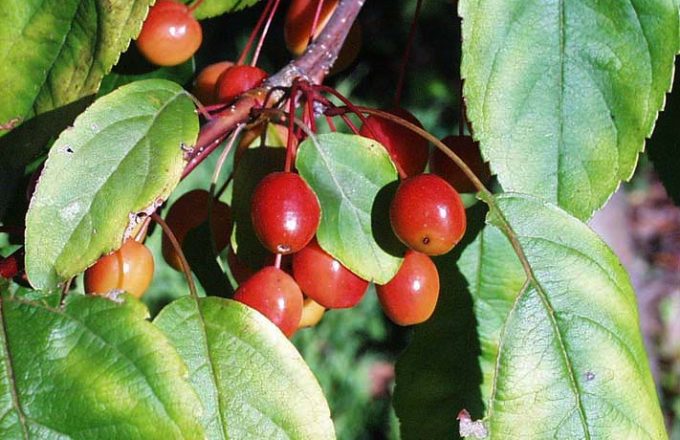
A great tree for the smaller garden is the Malus or crab apple with its fantastic fruits and autumn colour. One of Bridgette’s favourites is Malus x zumi ‘Golden Hornet’ which bears huge crops of bright yellow fruits that last on the tree well into autumn and winter.

  • Common name: Crab apple
  • Family: Rosaceae
  • Height & spread: 10m (30ft) high by 8m (25ft) wide
  • Form: Deciduous tree
  • Soil: Well-drained, neutral to alkaline soil
  • Aspect: Full sun or semi-shade
  • Hardiness: Fully hardy

The name Malus is from the Greek for ‘melon’, and a name applied to several trees with fleshy exterior fruits. This genus contains about 35 species of deciduous trees and shrubs, found in woodlands and thickets throughout northern temperate regions.

Malus are easily grown, small- to medium-sized trees flowering from April to May. They produce fragrant flowers 2-5cm (1-2in) across, usually shallowly cup-shaped, singly or in umbel-like corymbs.

Edible fruits follow the flowers.  Although some fruits do need cooking to be palatable, the fruit flavour improving considerably if the fruit is not harvested until it has been frosted. The fruit is quite variable in size (2-4cm diameter) and quality. While usually harsh and acidic, some cultivars are quite sweet and can be eaten raw. The fruit is rich in pectin and can be used to help other fruits to set when making jam. Pectin is also said to protect the body against radiation.

Bridgette’s favourite – Malus x zumi ‘Golden Hornet’:

It is a broadly pyramidal, deciduous tree bearing a profusion of large, cup-shaped pink-flushed white flowers opening from deep pink buds in late spring. Small, yellow crab apples follow, and persist well into winter. The display of golden fruit is further enhanced when the dark foliage turns yellow in autumn.

Grow in moderately fertile moist but well-drained soil in full sun, although partial shade is tolerated. Minimal pruning is needed in late winter or early spring, when the tree is dormant. Remove damaged, wayward or crossing shoots.

Problem pests can include – aphids, red spider mites, caterpillars, apple scab, honey fungus, canker, fireblight and mildew.

To propagate, bud in late summer or graft in midwinter

Awarded an Award of Garden Merit (AGM) by the RHS Woody Plant Committee who described it as: “Small deciduous tree with a broad ovoid crown and white flowers followed by a profuse crop of bright, deep yellow fruits 2.5cm long, which persist well into winter”.

Tulips – plan your planting now…

Posted by editor on Sunday, 7 November 2010

Tulips are fantastic spring bulbs.  There is nothing to beat them – for scent, colour and drama. If, like me, you want them to last for at least two months starting in the middle of March and continuing until the Alliums flower in May then you will need to do some planning.  It is such a lovely task on a gloomy evening to sit and look through the bulb catalogues and choose and plan your show!

Combining your tulips with spring flowering biennials, such as the deep red wallflower Erysimum ‘Blood Red’, or the orange, E. Fire King, or honesty, Lunnaria annua, will give a fantastic carpet of colour.

Plant some tulips for an early display, the Fosterianas are good, they have big flowers, and don’t forget the tall stemmed tulips like ‘Purissima’ or ‘Flaming Purissima’.  The Fosterianas are great in pots and they flower in March and early April.

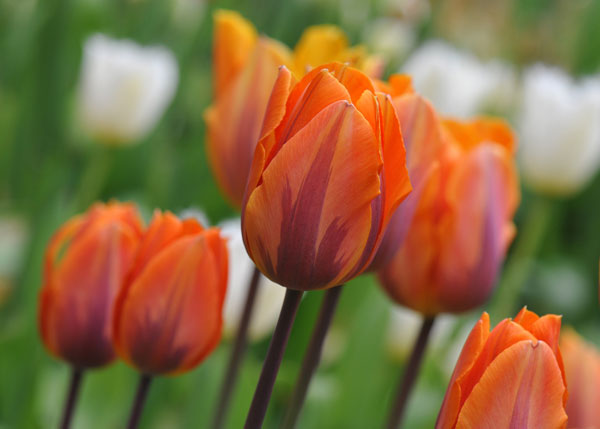
The species tulips such as Tulipa bakeri and T. clusiana also flower early in the year.  ‘Prinses Irene’ is an early tulip with gorgeous orange flowers, that have crimson and red streaks and is perfect for pots.

Make sure that your pots are clean as tulips are susceptible to blight which is transferred by spores and if your pots are not clean then they can become infected.

Next come the Triumph tulips and these will give you the earliest of the deep reds.  A mix of ‘Jan Reus’, the almost black ‘Queen of Night’ and the lovely deep purple ‘Recreado’ look sensational together and will flower around the middle of April.

The beautiful Parrot tulips come into bloom in the middle of spring and the form ‘Rococo’ looks brilliant with lettuces or the blood red Erysimum.  This is a great tulip for forcing and if you plant them in pots under cover you can manipulate them to flower by the middle of March.

The next ones are my favourites – the lily flowered tulips – and one of the most scented is ‘Ballerina’.  It is such an elegant tulip and looks wonderful with ‘Black Hero’, which is a double late form of ‘Queen of Night’ – it’s double flowers look peony like – there is a huge range of lily flowered tulips, ‘West Point’, ‘Burgundy’ and White Triumphator’ and Christopher Lloyds favourite,’ Queen of Sheba’, to name but a few.

Then finally to end the show some of the green-splashed ‘Viridifloras’ are long lasting and often flower year after year, which is a bonus.  The Parrot tulips, ‘Flaming Parrot’ and ‘Orange Favourite’ should see you through to the middle of May when the Allium ‘Purple Sensation’ is poised to take over.

The best time to plant tulips is after the first frost, or preferably frosts as these will kill off any fungal spores which are left in the ground, and is a good organic gardening method for getting rid of the disease tulip fire, (Botrytis tulipae), something that you really don’t want in your garden as it will kill all your tulips.

Try to plant your tulips at least 20cm/8” deep as this will ensure that any spores near the surface will not infect your bulbs.  Planted under shrubs will also allow your tulips to ‘die well’ as the shrub will provide a good foil for the dying leaves.

Order your bulbs on line at www.dutchbulbs.co.uk or call them on 0161 848 1124 if you prefer to study your bulbs in a catalogue.  This company also supplies A5 pictures of your chosen bulbs, (you can order them with your bulbs).  This is really helpful if showing bulbs to customers or if you are trying to decide on plant combinations.

At the Garden House we still have some bulbs for sale so why not drop by on Friday afternoon between 2.00 and 4.00pm for a slice of cake, a cup of tea and buy some bulbs to brighten up your spring!

Berry-licious! Jamming with The Garden house…

Posted by editor on Monday, 1 November 2010

Right now we’re jamming, pickling, bottling, – producing anything from creamy curds and chutneys to sparkling jellies and fruity jams. Many of us are using fruit and veg that we’ve grown in gardens and allotments or foraged from the hedgerows.

Applications for jam-making courses have soared. Preserving is a skill we’ve lost since the war as a result of having fridges and freezers. Before that preserving the bounties of our fruitful summer and autumn was a necessity. It was essential to stock up the larder for the leaner months when fresh food was scarce.

Today preserves may not be essential, but people are realising the satisfaction both in making them and in seeing them on the shelf.  We think jam-making works like a sort of safety valve – putting us back in touch with the seasons and satisfying our ‘hunter gatherer’ instincts.

Scour the hedgerows in the lanes for berries, hips, haws and crab apples to make Hedgerow Jam. The hedgerows are abundant at the moment and it is a joy to collect berries for preserving.

This weekend we held our Preserves Workshop – below is one of the recipes we made.  It is borrowed from Hugh Fearnley-Wittingstall’s book of preserves…

Hedgerow jelly (makes 7-8 x 225g jars)

Ingredients:

  • 1kg crab apples (or cooking apples)
  • 1kg mixed hedgerow berries (see above)
  • Around 900g granulated sugar

Method:

1. Pick over your fruit, removing stalks and rinsing if necessary. Don’t peel or core the apples as the peel and core are an excellent source of the naturally occurring gelling agent pectin. Just chop them roughly.

2. Place all the prepared fruit in a saucepan with 1.2 litres water. Bring gently to simmering point and simmer until the fruit is soft and pulpy.

3. Remove from the heat. Have ready a jelly bag or muslin cloth and turn the contents of the pan into it. Leave to drip overnight.

4. The next day, measure the juice – you will probably have about 1.2 litres (though this will depend on the berries used). For every 600ml juice, allow 450g sugar. Put the juice into a large pan and bring slowly to the boil. Add the sugar as it just comes to the boil and keep stirring until the sugar has dissolved. Boil rapidly, without stirring, for 9–10 mins until setting point is reached. Test this by dropping a little jam onto a cold saucer. Allow to cool for a minute then push gently with your fingertip. If it has formed a skin and crinkles a little, it’s set.

5. Skim the jelly, pot and seal as quickly as possible.

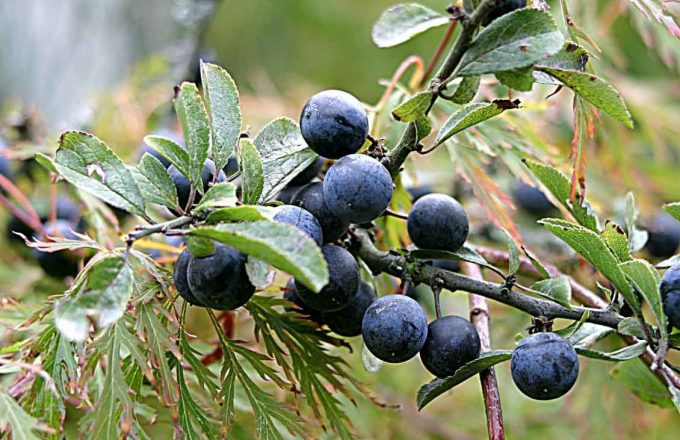
Berries that can be eaten and were included in our hedgerow jelly include: sloes (Prunus spinosa)crab apples (Malus sp)hawthorn (Crateageous mongyna), rowan berries, medlars and quinces.  Also the gorgeous orange berries of the sea buckthorn can be cooked and eaten.

Other autumn berries – not be eaten but which look fabulous in a vase – include Euonymus europaeus (common spindle), Ligustrum ovalifolium (Privet) with black berries, and Viburnum opulus (Guelder Rose)

We hope to run another preserves course early next year – we’ll let you know when!