Archive for January, 2011
Seedy Sunday, 6th February
Posted by editor on Sunday, 30 January 2011
Seedy Sunday celebrates its 10-year anniversary – 10 years of swopping seeds, hunting down disappearing or heritage varieties of flowering plants and vegetables. It is the UK’s biggest community seed swap.
Seeds are provided by the people who have grown them – volunteers and other gardeners donate saved seeds which are bagged up before the event – the seeds come in all shapes and sizes, often with stories attached!
Open-pollinated, ‘heritage’ varieties are often no longer commercially available, but are naturally well adapted to local growing conditions – as well as being tasty and colourful. At the seed swap, experienced local growers are on hand to advise on the practicalities of seed saving and growing from seed, and there are films, displays and talks to inspire you to go home and get growing. 
Also on offer – seed potatoes to info on recycling and wildlife, plants and bulbs – make this an ideal kick-start to spring!
And The Garden House will be there too, with seeds, bulbs and some wonderful dahlia varieties!
For more information on the Seedy Sunday campaign, go to www.seedysunday.org
Venue: Hove Centre, Hove Town Hall, Norton Road, Hove, E. Sussex / 10am-4.30pm / £2 entrance
Early spring…getting started!
Posted by editor on Saturday, 22 January 2011
Although the weather is still likely to be at its worst there will be plenty of signs that things are beginning to wake up. Bulbs are breaking through the soil, buds are beginning to swell on trees and shrubs, and inevitably you’re anxious to get working.
Begin by tidying old leaves left on herbaceous plants by cutting with shears, and rake out rubbish and leaves that have collected under shrubs.
This helps prevent pests and disease harbouring in piles of rotting vegetation. Do bear in mind that weeds will still grow this time of year, especially if this month stays frost free and damp. Remove these ensuring deep roots of perennial weeds are dug out completely.
If soil is prepared for planting cover it with polythene sheeting, this will stop it from getting wet and warm the soil so that when you do plant they will get away quicker.
It’s an ideal time to plant any new bare-rooted specimens, such as deciduous trees and shrubs along with roses. These will benefit from the addition of slow-release fertiliser to the surrounding soil, which in turn should be applied to all your beds.
It is also time to prune late-flowering clematis. These flower on the current years growth, so cutting the stems hard now will prevent plants becoming tangled and untidy. Cut back to the hard woody stems, removing any green growth from last year.
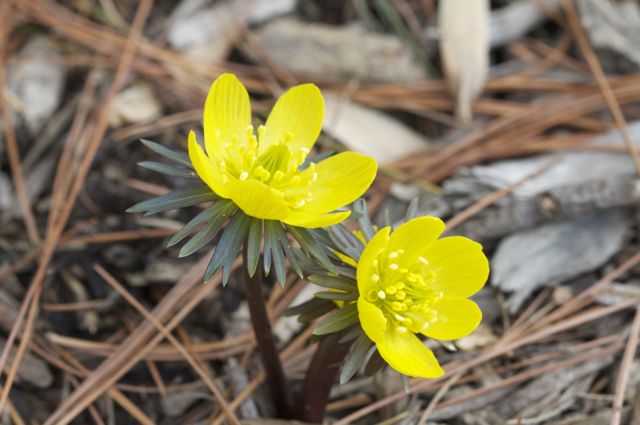
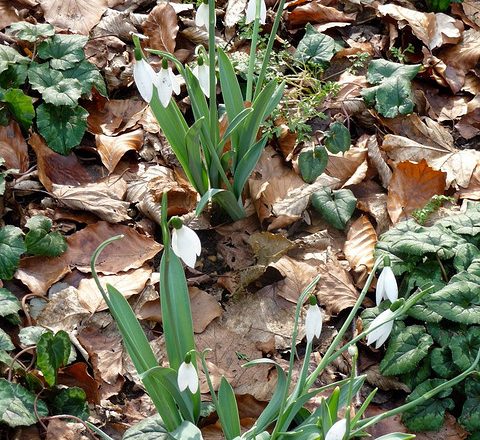
Take pleasure in the emerging snowdrops, aconites and cyclamen – they may be small, but they are also wonderfully colourful! Just what’s needed to cheer you up on a cold misty morning. 
The best place to be at this time of year is in the greenhouse, but don’t start your annuals to early, it’s a long time for seedlings to be in trays and they could get drawn.
Since we have many frosty days this month, it’s a great time to find a comfy seat, a steaming cup of coffee and cake – and look through the seed, plant and landscaping catalogues to let you imagination run wild and decide how you can improve your garden this coming year…
PART 4 of our Competition! Win a visit to Anglesey Abbey…
Posted by editor on Tuesday, 18 January 2011
Last part of our four-part Gardening Quiz! Win a seat on our visit to the stunning Anglesey Abbey on 12 February…
The garden’s highlight is its stunning Winter Garden, and is at its most spectacular in early spring when drifts of white snowdrops and yellow aconites add colour to the frosty landscape…
GARDENING QUIZ: PART 4
1) Which of the following does the disorder end rot affect?
- Pears
- Cucumbers
- Tomatoes
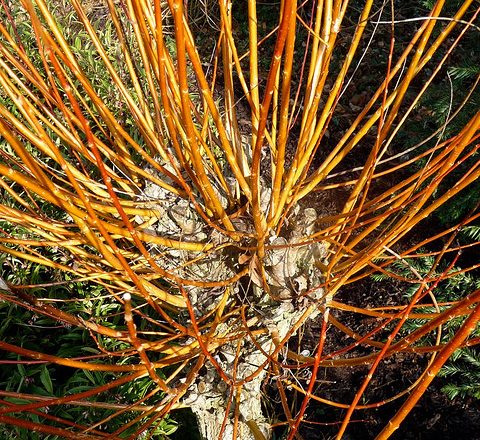
2) For the longest, most coloured stems when should Cornus alba ‘Sibirica’ be annually pruned?
- Early spring
- Early summer
- Early autumn
3) For what is Gertrude Jekyll best known?
- A garden photographer
- A plant hunter
- A garden designer
4) A tree trained with a vertical main stem and tiers of horizontal branches is described as?
- A single cordon
- An espalier
- A multiple cordon
5) Which plant is NOT a common nectar source for butterflies and bees?
- Buddleja davidii ‘Empire Blue’
- Sedum spectabile ‘Brilliant’
- Miscanthus sinensis
6) What has the botanical name of Citrus reticulata?
- Lime
- Grapefruit
- Tangerine
7) Which of the following is normally planted to provide scent in the winter?
- Cornus alba ‘Elegantissima’
- Chimonanthus praecox ‘Luteus’
- Corylus avellana ‘Contorta’
8) What does mulching NOT normally help?
- Reduce soil water loss
- Control weeds
- Control pests and diseases
9) To which plant family does Ilex (holly) belong?
- Berberidaceae
- Celastraceae
- Aquifoliaceae
10) What does the term corymb describe?
- The inflorescence
- The leaf margin
- The petal shape
INSTRUCTIONS:
Print off each of the four quiz parts, ring around the correct answer, add your name and address (of course!) – and post to Bridgette and Deborah at The Garden House, 5 Warleigh Road, Brighton BN1 4NT
Answers must be received by 25th JANUARY – and we’ll announce the winner by the end of January – best of luck!
PART 3 of our Competition! Win a visit to Anglesey Abbey…
Posted by editor on Friday, 14 January 2011
Take part in our four-part Gardening Quiz and win a seat on our visit to the stunning Anglesey Abbey on 12 February.
The garden’s highlight is its stunning Winter Garden, and is at its most spectacular in early spring when drifts of white snowdrops and yellow aconites add colour to the frosty landscape…
GARDENING QUIZ: PART 3
1) Which tree is associated with the first of the 12 days of Christmas?
- Pyrus
- Fagus
- Quercus
2) Which of these four nutrients is especially associated with fruit development?
- Nitrogen
- Magnesium
- Potassium
3) To which country is the poinsettia native?
- Thailand
- Chile
- Mexico
4) Bulbs consist of swollen?
- Stems
- Leaves
- Roots
5) Which of the following fruits is botanically unrelated to the other three?
- Bilberry
- Wineberry
- Blueberry
6) What is the common name for Euphorbia pulcherrima?
- Loquat
- Taro
- Poinsettia
7) Which tree fruit is botanically described as a pome?
- Mulberry
- Apple
- Walnut
8) Which of the following magnolias is evergreen?
- Magnolia hypoleuca
- Magnolia grandiflora
- Magnolia salicifolia
9) To which plant family does Hedera helix (common ivy) belong?
- Araliaceae
- Convolvulaceae
- Vitaceae
10) Which of the following terms is often used to describe irises?
- Ball
- Pompom
- Bearded
INSTRUCTIONS:
Print off each of the four quiz parts, ring around the correct answer, add your name and address (of course!) – and post to Bridgette and Deborah at The Garden House, 5 Warleigh Road, Brighton BN1 4NT
Answers must be received by 25th JANUARY – and we’ll announce the winner by the end of January – best of luck!
PART 2 of our Competition! Win a visit to Anglesey Abbey…
Posted by editor on Monday, 10 January 2011
Take part in our four-part Gardening Quiz and win a seat on our visit to the stunning Anglesey Abbey on 12 February.
The garden’s highlight is its stunning Winter Garden, and is at its most spectacular in early spring when drifts of white snowdrops and yellow aconites add colour to the frosty landscape…
GARDENING QUIZ: PART 2
1) Chestnuts come from which tree?
- Fagus sylvatica
- Castanea sativa
- Carpinus betulus
2) Which of the following is a garden variety of Hosta?
- ‘Christmas Angel’
- ‘Christmas Gift’
- ‘Christmas Cheer’
3) Who amongst the following was a famous plant hunter?
- David Douglas
- Lancelot Brown
- Humphry Repton
4) Which of the following Clematis flower in the winter?
- Clematis viticella
- Clematis montana
- Clematis cirrhosa
5) Cuckoo spit is caused by?
- A bird
- An insect
- A fungus
6) What has the botanical name Dierama?
- Angel’s tears
- Angel’s trumpets
- Angel’s fishing rod
7) Paliurus spina-christi is commonly called?
- Thorn apple
- Christ’s thorn
- Christmas thorn
8) In which county is Stowe Landscape Garden?
- Buckinghamshire
- Berkshire
- Shropshire
9) Which of the following is semi-parasitic?
- Honeysuckle
- Ivy
- Mistletoe
10) The spice cinnamon comes from which part of Cinnamomum verum?
- Seeds
- Fruits
- Bark
INSTRUCTIONS:
Print off each of the four quiz parts, ring around the correct answer, add your name and address (of course!) – and post to Bridgette and Deborah at The Garden House, 5 Warleigh Road, Brighton BN1 4NT
Answers must be received by 25th JANUARY – and we’ll announce the winner by the end of January – best of luck!
PART 1 of our Competition! Win a visit to Anglesey Abbey…
Posted by editor on Thursday, 6 January 2011
Take part in our four-part Gardening Quiz and win a seat on our visit to the stunning Anglesey Abbey on 12 February.
The garden’s highlight is its stunning Winter Garden, at its most spectacular in early spring when drifts of white snowdrops and yellow aconites add colour to the frosty landscape…
GARDENING QUIZ: PART 1
1) Which plant has the common name of Christmas Rose?
- Helleborus niger
- Saracococca
- Sedum rubrotinctum
2) What is a terrarium?
- An ornamental support for growing roses
- A digging tool
- A sealed glazed case for growing plants
3) What colours are the flowers of Camellia ‘Leonard Messel’
- White
- Pink
- Yellow
4) From which continent does Schlumbergera (Christmas cactus) originate?
- Africa
- South America
- Europe
5) Perlite and vermiculite are?
- Pesticides
- Compost additives
- Herbicides
6) What is an ‘iron pan’?
- A pot used for alpines
- A way to control weeds
- A soil condition
7) Which of the following is a garden variety of holly?
- ‘Glacier’
- ‘Sulphur Heart’
- ‘Goldchild’
8) A short stump of branch left after incorrect pruning is?
- A sport
- A break
- A snag
9) What is the usual number of petals on an Aubretia?
- Three
- Four
- Five
10) Which of the following plants can be most easily propagated by root cuttings?
- Anemone x hybrida
- Dianthus barbatus
- Quercus robur
INSTRUCTIONS:
Print off each of the four quiz parts (published through early January), ring around the correct answers, add your name and address (of course!) – and post to Bridgette and Deborah at The Garden House, 5 Warleigh Road, Brighton BN1 4NT
Answers must be received by 25th JANUARY – and we’ll announce the winner by the end of January – best of luck!
Who will be the first to spot a snowdrop?
Posted by editor on Sunday, 2 January 2011
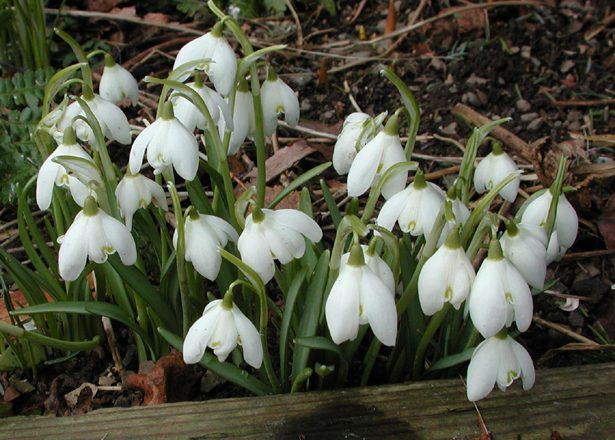
Galanthus is a small genus of about 19 species of bulb commonly found throughout Europe and western Asia in upland woodland and rocky sites. Galanthus bloom mainly from late winter to mid-spring, though in their natural habitat they often flower just as the snow is starting to melt.
The name Galanthus is derived from the Greek words gala, meaning milk, and anthos, meaning flower, in allusion to the colour of the flowers. The plants are more commonly known as ‘snowdrops’, from the German Schneetropfen – this common name refers to a style of earring popular in the 16th and 17th centuries in Germany.
One of the best and boldest of the snowdrops, with rounded bell-shaped scented flowers, is variety ‘S.Arnott’ – a favourite of ours!
- Family: Amaryllidaceae
- Height & spread: 15cm (6in) x 8cm (3in)
- Form: Bulbous perennial
- Soil: Moist but well-drained, moderately fertile
- Aspect: Cool shade
- Hardiness: Fully hardy
This snowdrop is vigorous, with narrow, grey-green leaves 7-16cm (3-6in) long. It has large white flowers, which have an inverted V-shaped green mark at the tip of each inner tepal. They are 2.5-3.5cm (1-1.5in) long, strongly honey-scented and are produced in winter and early spring. They look wonderful planted with dark-leaved plants, like Ophiopogon planiscapus ‘Nigrescens’ or with bright yellow winter aconites, or carpeting the woodland floor under a flowering witch hazel. 
Cultivation: Snowdrops grow well in cool shade in any humus-rich, moist but well-drained soil that does not dry out in summer.
They are prone to narcissus bulb fly, which will tunnel into the bulbs and destroy them, and also grey mould (botrytis), which will appear on the leaves but then rot the bulbs.
Propagation: Sow seed as soon as ripe in containers in an open frame, though as Galanthus species readily hybridise the seed may not come true.
Propagate by twin scaling in summer. With this technique a bulb is cut into pairs of scales, each of which produces bulblets.
Lift and divide clumps of Galanthus “in the green”, as soon as the leaves begin to die back after flowering. Replant each bulb individually, at the same level as before, in holes sufficiently wide to spread out the roots.
When all else is bare, it lifts the spirits when you spot patches of snowdrops appearing under shrubs and trees…
If you want to see many, many varieties of Galanthus growing wild (including many rare varieties) – join us on 12 February for an early spring visit to the stunning gardens of Anglesey Abbey. Truly a garden for all seasons – but particularly beautiful in February when it is at it’s most spectacular, and drifts of white snowdrops and yellow aconites add colour to the frosty landscape (details in the DIARY on this website)…