Archive for April, 2011
Royal Wedding Flowers and Trees
Posted by editor on Friday, 29 April 2011
Love it or loathe it, endure it or enjoy it – today’s wedding was a great opportunity to again admire the beauty of our seasonal native trees and flowers.
London-based floral designer Shane Connolly masterminded the floral arrangements, leading teams of florists in decorating Westminster Abbey and of course, designing the bride’s bouquet. Connolly is known for his “sustainable approach to floristry,” and often uses live growing plants and trees in his designs.
The overall impression was of natural elegance, simplicity and seasonality – white and cream, scented and full of meaning.
At Westminster Abbey the nave was lined with an ‘avenue’ of eight 20ft-high trees, six English Field Maples and two Hornbeams, all growing in planters made by craftsmen at Highgrove, the Prince of Wales’s house in Gloucestershire.
Among the seasonal cut stems decorating the abbey were azaleas, rhododendron, euphorbias, Solomon’s seal, wisteria and lilac – all grown in Britain.
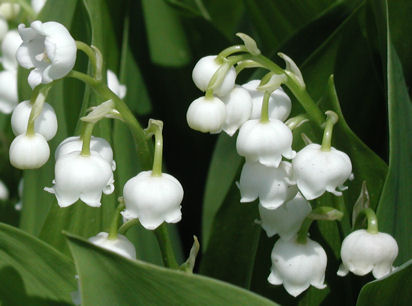
Kate’s bouquet was white, scented and simple. It was a shield-shaped wired bouquet comprising myrtle (signifying love and taken from an original myrtle planted at Osborne in 1845, which still thrives within its sheltered terraced gardens today), lily-of-the-valley (humility, purity), sweet William (gallantry) and white hyacinth (loveliness). The majority of the flowers came from Windsor Great Park’s Valley Gardens, a flowering forest in Surrey.
The flowers and plants will remain in the abbey for public viewing until 6 May, when the trees will be taken to Highgrove Gardens for planting. Most of the cut flowers and greenery and growing plants will be given to charities or replanted.
Lift your tulip bulbs for next year
Posted by editor on Sunday, 24 April 2011
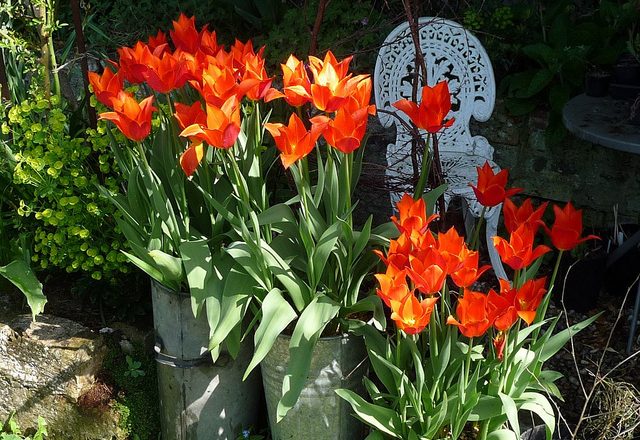
Some bulbs, like daffodils and jonquils, are fine to leave in the ground season after season. However tulips are best dug up and left to dry out. Some tulip bulbs are not winter hardy, hence in cold climates those bulbs should be lifted and stored to be used the next season.
After flowers have finished, cut off the spent flower stems but do not cut back the foliage. Ideally leave in the ground for 2-3 weeks as the period of time after blooming is when tulips use energy to build strong bulbs for next year’s blooms. If you cut off the leaves before they died down naturally, the bulb will not have the reserves to grow and flower the following season. Tulips, unlike daffodils, do not require foliar feed in order to build up the bulb.
With a garden fork carefully prise them from the soil. All physically damaged bulbs should be discarded.
Wash any remaining soil off the bulb and then place as a single layer in a basket or tray that has enough air move through it. The bulbs can also be stored in a paper bag. Carefully label each bag or tray especially if you have different varieties.
Store in a dark, cool and dry place that is well ventilated. Make sure that the temperature is constant. Check regularly and remove any bulbs showing signs of mildew or rotting. Shaking the bulbs in a plastic sack with a little fungicide is a good measure of prevention.
Store until autumn when you can begin to divide the bulbs and replant. The best way to nourish your tulips is to lay down a top dressing of bone meal in the autumn to enrich the soil.
Margaret’s Easter Cake (Frangipane/Almond tart)
Posted by editor on Tuesday, 19 April 2011
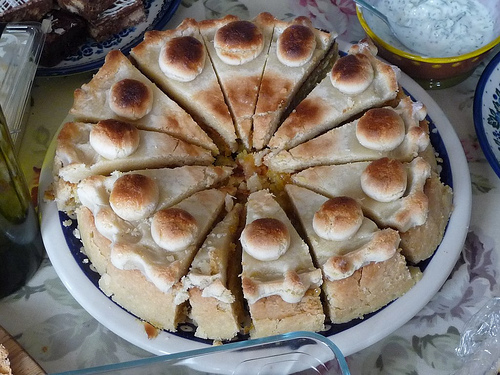
We love Margaret’s delicious version of the traditional Simnel cake; a cake typically eaten during the Easter period in Great Britain, Ireland and some other countries.
For the base:
- 8oz rich shortcrust pastry (use ready-made Jus-Rol sweet shortcrust)
- Apricot jam or conserve
For the cake mixture:
- 4oz ground almonds
- 4oz caster sugar
- 4oz unsalted butter
- 1 tbls plain flour
- 2 medium eggs
- Orange flower essence (optional)
For the almond paste topping:
- 8oz ground almonds
- 8oz caster sugar and icing sugar (roughly half/half each)
- 1 medium egg
- 1tsp lemon juice
Method:
- Cake:
- Medium oven 150c or gas mark 4
- Roll out pastry and line an 8” tart tin (no need to pre-bake)
- Coat bottom of tart with apricot jam or conserve (about 1 tbls)
- To make cake mixture, beat the sugar into the softened butter
- Fold in almonds and flour, then gradually add in eggs beating as you add
- Add a few drops orange flower essence (optional)
- Pour mixture into tart and cook for approx 40-45 mins
- Set aside to cool
- Almond paste topping:
- Sift icing sugar into a bowl, add caster sugar and ground almonds, mix together
- Stir in the beaten egg and 1 tsp lemon juice to make a fairly stiff lump
- Cut off a piece and make 12 small balls of paste (eleven marzipan balls represent the true disciples of Jesus; Judas is omitted – in some variations Christ is also represented, by a ball placed at the centre. We suggest, to make cutting easier, use twelve balls around the edge)
- Smooth the remaining paste over the cooled cake
- To finish, giving that slightly ‘toasted’ colour, put under the grill or back in the oven for 2/3 minutes until lightly browned.
Margaret has been gardening at The Garden House for many years as one of the regular ‘Friday group’ of women who keep this wonderful garden looking at its best. Margaret’s particular gardening loves are roses, knot gardens and garden history.
We love: Fritillaria
Posted by editor on Monday, 11 April 2011
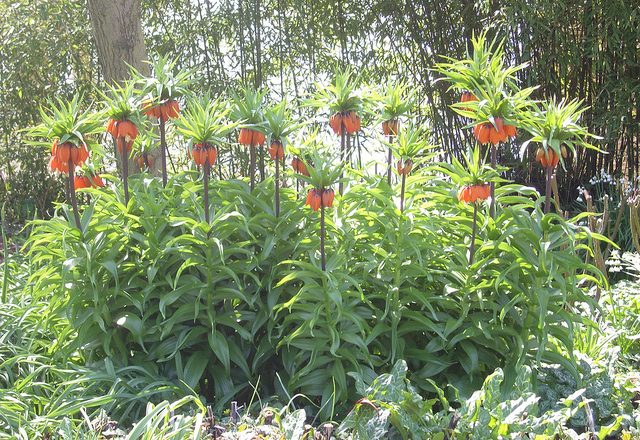
This fascinating genus contains over 100 species of bulbous perennials, from the tall and dramatic F. imperialis (Crown Imperial) to the delicate F. meleagris (snake’s head fritillary) with its distinctive chequered flower. In the main they originate from around the Mediterranean, Asia and North America (F.meleagris is the one species of fritillaria thought to be native to Britain).
The majority bloom in spring and have distinctive flowers that are generally bell-shaped and pendant. These hardy bulbs need deep, rich and well draining soil and should be planted in autumn to a depth of at least twice that of the bulb. They can also be successfully grown in pots, which in the case of F. imperilais is helpful, making them easier to move under cover during the winter months.
Other favourites include F. persica, a deep dusky mauve, and F. persica Ivory Bells. Flowers are held in long racemes of up to 30 narrowly bell-shaped somewhat conical flowers, about ¾” long with a waxy bloom.
Also look out for Fritillaria michailovskyi, it has up to five, pendant reddish-purple bells with a yellow edge on the outside and a shiny yellow interior. Like F. meleagris it is only 8-10” tall, an exquisite woodland or river meadow gem.

Our favourite flowering cherries…
Posted by editor on Sunday, 3 April 2011
In Japan, where the cherry blossom is respected, there is an annual festival in its honour, where everyone goes out into the countryside to sit beneath the blossom and picnic and party with very un-Japanese abandon.
Cherries are one of the most attractive and versatile of garden trees, giving delightful spring colour when they are in full blossom and, in many cases, outstanding autumn colour as well.
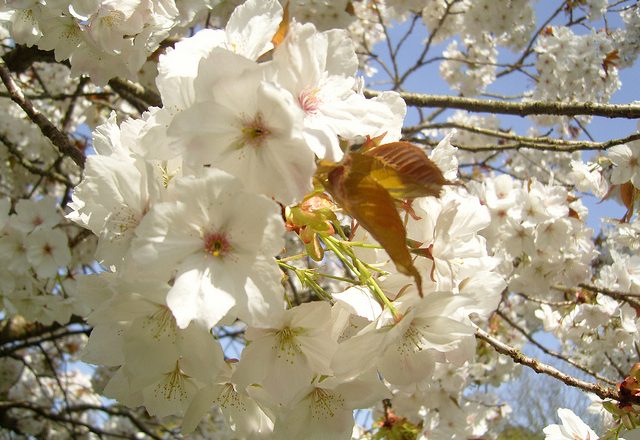
At the Garden House we have a stunning Prunus serrulata ‘Tai Haku’. Its spindly branches hanging with extraordinary bundles of huge white blossoms, delicate explosions of petals freeze-framed in mid-air.
‘Tai Haku’ is a cherry with an astonishing story too: a legendary tree in Japan until it disappeared at the end of the 18th century, it was apparently unknown anywhere else in the world. Then, in 1923, the owner of a Sussex garden showed Captain Collingwood Ingram – an expert on Japanese cherries – an unidentified cherry with gorgeous white flowers. He was unable to recognise it but took grafts and passed the resulting saplings around.
The next time he went to Japan he was shown an 18th-century book of flower paintings and recognised the unidentified white cherry from the Sussex garden. As far as the Japanese were concerned, however, ‘Tai Haku’ had disappeared and could not possibly have popped up a hundred years later in England. It really does appear, though, that every ‘Tai Haku’ in cultivation – which vanished from Japan 200 years ago – inexplicably comes from that Sussex tree found 87 years ago.
- Prunus ‘Kursar’ AGM – this stunning small tree was one of the best trees raised by Captain Collingwood Ingram. It has masses of small deep pink flowers and fantastic autumn colour.
- Prunus incisa ‘The Bride’ – in spring this small cherry, which has a dense shrubby growth habit, is smothered with large single white flowers. The anthers of the flower are a very vibrant red colour and this is emphasized against the white petals.
- Prunus ‘Shogetsu’ AGM – this is one of the finest Japanese cherries and has a wide spreading growth habit. It has large double pink flowers which hang from the branches in clusters providing a breathtaking display. The double pink flowers quickly fade to a beautiful pure white.
- Prunus ‘Accolade’ AGM – this cherry has a spreading growth habit. During April the tree is covered in masses of large light pink semi-double flowers. It will also add value to your garden during the autumn when its green leaves turn a vivid rich orange/red colour.
- Prunus incisa ‘Kojo-no-mai’ – this delightful small cherry is very slow growing and compact making it suitable for growing in containers. Its branches have a fascinating zigzag growth habit and these are covered in small blush pink flowers. In the autumn this cherry will reward you with great foliage colour.
- Prunus ‘Pink Perfection’ AGM – this stunning cherry has bright double pink flowers which hang in drooping clusters from the branches. The leaves are a delicate bronze colour when young, before turning green and then a bright fiery red and orange in the autumn.
More cherries for small gardens:
- Prunus x subhirtella ‘Fukubana’ – this is an elegant miniature tree to about 3m that will fit into a small space and give it scale.
- Another good choice is Prunus x subhirtella ‘Autumnalis’ (winter-flowering cherry) – this is a real harbinger of spring that will repeat flower in any mild spell between January and March. It makes an elegant small tree of about 6-7m with an open head casting light shade. The single white flowers have pink centres and the bark is dark brown and shiny.’
- Prunus incisa ‘Fujima’ – this shrubby-crowned small tree is smothered in masses of pink-tinged flower buds, followed by stunning white flowers. It is very free-flowering, quick to establish and adaptable – it grows on heavy clay. The cultivar also offers good autumn colour.
- Prunus ‘Spire’ AGM – a fine choice for a small garden. This cultivar is no more than 2m wide when it is 20 years old. It has an upright crown meaning it will fit into the smallest space and give height or screen a view. The pale pink blossom covers the tree in spring and the autumn leaf colour is orange to yellow.
It is worth noting that ornamental cherries budded on to wild cherry rootstocks have large root systems, whilst trees on their own roots have much smaller root systems and are therefore better for smaller gardens.