Archive for August, 2011

Mark the date: Sussex Prairies Garden, 4 September

Posted by editor on Monday, 29 August 2011

Well worth a visit – on Sunday 4 September 2011 (from 11am until 5pm) a rare collection of exciting nurseries, artists and crafts people will be coming together at the Sussex Prairies Garden. Over 60 stalls will be displaying a great selection of unusual plants and beautiful pieces for you to buy.

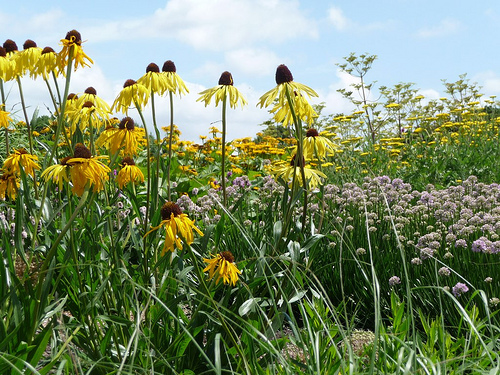
The Sussex Prairies Garden also happens to be one of our favourite gardens, renowned for its dramatic drifts of late summer-flowering perennials.

The Garden House will be there – ready to discuss our forthcoming (and very exciting) Christmas and 2012 courses, workshops, garden visits and talks (evening talk with Fergus Garrett at GH on 23 March 2012!).  We’ll also be selling GH-made preserves and a variety of seeds and plants.

Plant exhibitors include:

  • DESIRABLE PLANTS – Specialising in herbaceous perennials, Epimedium and other woodlanders, Galanthus, Watsonia, Gladiolus, Tritonia and other South African Iridaceae, outh African Erica, Sanguisorba, Geranium, Hedychium and Roscoea. www.desirableplants.com
  • SCARECROW PLANTS – Out of the ordinary plants, English Native wildflowers and plants to attract wildlife. Also hand-made local ironwork and trellis. 07939 272443
  • RAPKYNS NURSERY – All grown in their traditional nursery – a unique and exciting range of quality and unusual cottage garden plants. 01825 830065

Art exhibitors include:

  • ANNEMARIE O’SULLIVAN – whose passion lies in all things woven, knotted and netted, will be showing baskets and larger woven forms. www.annemarieosullivan.co.uk
  • FRANCES DOHERTY  – extraordinary ceramics based on the forms of fruiting bodies, flowers and particularly seedpods. Richly glazed to complement the form and often combined with metal and reclaimed sea defence timber. www.francesdoherty.co.uk
  • CHRIS BURCHELL COLLINS – A Blacksmith and Green Woodworker whose work is influenced by the wonderful forms and shapes found in nature.
  • JANINE CREAYE – will be bringing many new small sculptures for gardens and interiors. Stylised and patterned wood carving, stone carving and drawings of natural forms. www.sculptureform.co.uk
  • HOLLY BELL – wheel-thrown functional ceramics including jugs, tea-sets and planters. www.hollybell.co.uk

And many, many more – a great chance to source some amazing plants and artifacts for you, your house and your garden! For more information visit www.sussexprairies.co.uk

Inspired in Edinburgh…

Posted by editor on Wednesday, 24 August 2011

Edinburgh in August means Festival time, and I have just spent three wonderful days enjoying a cultural feast, ­­­­involving the serious, the brilliantly clever, the poignant and the daft, and all thought provoking.

We heard one of three pieces composed and played by Philip Glass, accompanying a mesmerising film, Naqoyqatsi, a series of images about “civilised violence”.

At the Book Festival I particularly enjoyed a discussion between Tom Hodgkinson and Matthew de Abaitua about returning to a simpler way of life, which felt very in tune with what we are supporting here at the Garden House.  Tom’s book Brave Old World, a Practical Guide to Husbandry, celebrates former ways of life, and how to live sustainably, and with humour.

I failed in my mission to see one of the events, Allotment, “exploring the powerful legacy of generations of gardeners”, and actually held in the real Inverleith allotments, but I did manage a few hours in the botanic gardens which are absolutely wonderful, currently with an inspirational exhibition using recycled materials.

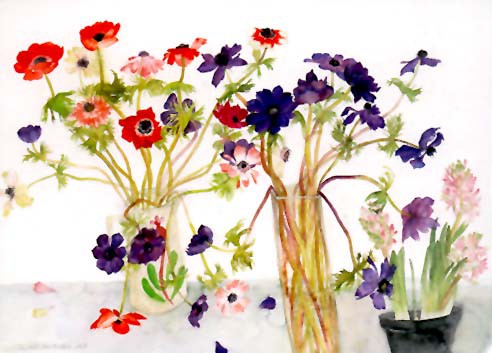
Elizabeth Blackadder, well known for her paintings of flowers, in particular irises, has a marvellous and extensive retrospective exhibition at the Scottish National Gallery.

As well as the above, I saw a brilliant expressive production at the Dancebase called Silent, about a homeless person; and a joyful show by four young men from South Africa called Soweto Entsha, which made me determined to return to that wonderful country!

My sister lives in Edinburgh and may be doing bed and breakfast in her very central, and gorgeous, location for next year’s festival, so keep watching this space for more details…

IMAGE:  Anemones and Hyacinths by Elizabeth Blackadder

Poem by Renee McAlister (gardener, and Garden House friend)

Posted by editor on Friday, 19 August 2011

Rudolph and Peter’s Garden, Early June, Late Afternoon 2011

Poem by Renee McAlister (gardener, and Garden House friend)

Alcanet fusing with Geranium.

African daisies shut-shy without sun.

Bristling box with stray branches untrimmed.

Spidery Iris like bee’s eyes: undimmed.

The garden, in thickets of late afternoon,

is unsettled still, but will still with the moon.

Bamboo is bracing. The pace of the breeze

speeds up as it batters the flat leaves of trees.

Buddleia’s budding. Its dark brush will come

and paint purple parapets, spires of plum.

Hazel-shade shadows the dead Bleeding Hearts,

whose slow-beating life will return when spring starts.

Cornus and Hollyhock, safe below Birch.

Cranesbill, through Hebe, continues its search.

Grasping at Fuchsia, Lonicera climbs,

its aroma a rhyme to the Fuchsia’s white chimes.

Cloud Ceanothus that mirrors the sky

in the spring, as it screams out its blue battle cry.

A straggle of Chives guards Begonia’s blooms

while a pale Helichrysum frisks them with fumes.

A wind from the South shakes the sound from the sea

and, though sirens splash shouts through the green, I am free

in the salt-saturated and seagull scared air

watching gold Philadelphus shed petals and care.

The harsh scent of Rosemary drops on the grasses

whose shoulders are hunched, for they hide as time passes.

The courage of Quaking Grass staking its claim

as it eases itself through Tobacco Plant’s flame.

There are boxes of Basil, of herbs and of Pinks.

No longer a wall where the great Ivy thinks

of another wall, other bricks, render and tiles

onto which it can cling, onto which live for miles.

The South facing border is pent up and primed.

Imposing Anemones, growing in lime,

shift their corpulent foliage east and then west

and Verbena unfurls fists of mauve at its crest.

The soft Dusty Millers, all purring and fur,

press their paws in the earth as if to deter

the encroaching Hydrangea with flattened false flowers,

its patterned white plates making meals out of hours.

The chattering Strawbs are absorbing the light

as they gossip of red flesh and talk of the night.

The Cardoon is King, though it waits for its crown,

its cut-silver accent born far from this town.

Spent stars of Allium wait for their kin

to appear in the black of the night’s fleeting skin.

Columbines colonise unconquered soil

and Sedums seem infused with bright, verdant oil.

As Lavender licks at the last of the light

and the sun seethes and settles, bemoaning the night,

and the wind slaps a cold evening hand on my back,

I walk back to the house. We all walk into black.

Flower of the month: Passiflora (the passion flower)

Posted by editor on Sunday, 14 August 2011

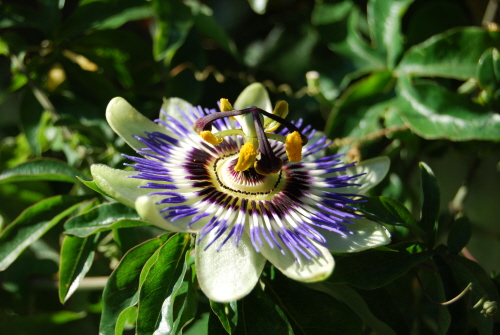
At this time of year, hardy Passiflora are in full bloom.  A wonderfully exotic-looking plant, the Blue Passion Flower (P. caerulea) has large white flowers and central filaments of purple, blue and white, followed by egg-shaped, orange-yellow fruit, and flowers from July to September. The fruit are edible, but not very tasty and not to be confused with ones you can buy in the supermarkets!

This vigorous, trouble-free climber looks really good in a tropical planting scheme, and will grow best at the base of a sheltered wall in full sun, although they can tolerate some shade. Even the leaves and tendrils look other-worldlly, deeply lobed, dark green and glossy. It is frost hardy but may need some winter protection in cold areas.  The eventual height is 10 metres.

The “Passion” in “passion flower” refers to the passion of Jesus in Christian theology. In the 15th and 16th centuries, Spanish Christian missionaries adopted the unique physical structures of this plant, particularly the numbers of its various flower parts, as symbols of the last days of Jesus and especially his crucifixion:

  • The pointed tips of the leaves were taken to represent the Holy Lance
  • The tendrils represent the whips used in the flagellation of Christ
  • The ten petals and sepals represent the ten faithful apostles (excluding St. Peter the denier and Judas Iscariot the betrayer)
  • The flower’s radial filaments, which can number more than a hundred and vary from flower to flower, represent the crown of thorns
  • The chalice-shaped ovary with its receptacle represents a hammer or the Holy Grail
  • The 3 stigmas represent the 3 nails and the 5 anthers below them the 5 wounds (four by the nails and one by the lance)
  • The blue and white colours of many species’ flowers represent Heaven and Purity.

There are many other beautiful passion flowers but many of them need to be protected and are best grown in a glass house or conservatory.

Being easy to grow they require little maintenance, but if you don’t want them to reach too high, plant in pots or tubs and let them grow up and cascade over an obelisk.

Choose three to five of the strongest shoots, tying them in to horizontal wires. Once the plant is established, cut back the flowered shoots immediately after flowering to within two or three buds of the permanent framework of the plant. In spring remove dead, misplaced or overcrowded stems.

If you want to find out more about passion flowers, Passiflora: Passionflowers of the World by Torsten Ulmer and John M. MacDougal is a really good read.

Thinking of booking an idyllic last-minute holiday?

Posted by editor on Wednesday, 10 August 2011

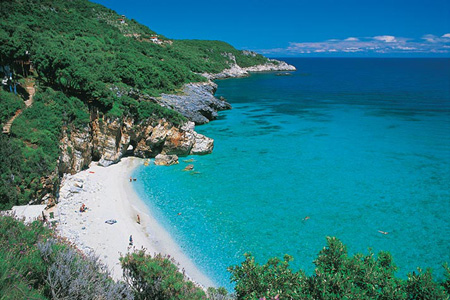
Spending time in my house in Metochi is very restorative. Here in Pelion one gets no sense that Greece is suffering at the moment, except for the emptier beaches and tavernas.  The Greeks are on holiday, and Pelion is the place they come to, following in the footsteps of the Gods who were said to come here for their vacations!  Pelion, according to Greek mythology, is the Land of the Centaurs. Here the mountain air is admired for its healing powers and is most welcome after a day on a warm beach.

My beautiful stone house is built on a hillside facing the Pagasitikos Bay, and village life continues around us as we soak in the lovely views, sitting in the garden. I’ve tried to plant as many fragrant herbs and climbers as possible, creating a pretty heady fragrance as one enjoys a glass of wine at the end of the day.

On this holiday I’ve thinned and cut down the rather invasive Arundo Donax* which grows wild below us, exposing the great view but keeping enough to disguise the little hut where some neighbours run a still – used to produce the lethal local tipple, Tsipouro!

Apart from the Tsipouro, Metochi water is famous in the area, collected chilled direct from the spring.  When we wander out in the evening, we often head over to Dimitri’s local taverna, where he serves freshly prepared food and local wine cheaply.

The beaches are incredible and varied, ranging from many on the more gentle shores of the Pagasitikos Bay to the more rugged coastline facing the Aegean Sea.  Yesterday it was like being on a Cornish beach but the temperature was about 38◦ (and lunch was a lot cheaper than Calamares and salad in a Cornish seafood restaurant!).

Unusually, the house is vacant for the next couple of weeks until 28th August so if anyone is in search of a relaxing last minute holiday, please contact me as soon as possible. Flights are not very expensive and still possible to find – to either Athens or Thessalonika, where you can get express buses to Volos and pick up a hire car, or hire a car direct from the airport.  For photos and more information, go to www.realholidays.co.uk – click on Special Places, then Metochi…

*Arundo Donax – a giant reed – thought to the be the origin for the pipes of Pan.  Ovid tells the legend of Pan who suffered unrequited love for the nymph Syrinx.  As soon as Pan came near to her, Syrinx called to her sisters for help, until the exasperated Pan transformed them all into a dense bunch of reeds.  He then cut a number of the tubular stems into different lengths and united them with wax to form the wind instrument known as the Pipes of Pan.

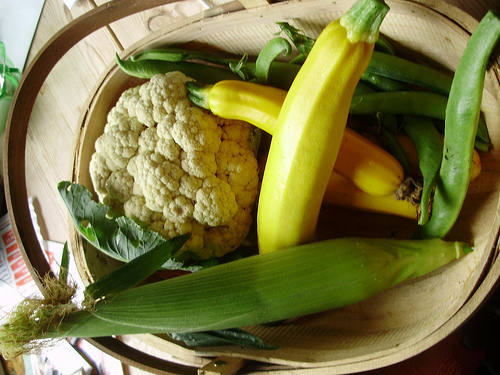
My magnificent cauliflower!

Posted by editor on Tuesday, 2 August 2011

This photo was sent into us by Juley, who attended one of our Garden House practical gardening courses.  We can’t claim all the glory of course (our amazing horticultural teaching skills!), but we did think it was a magnificent crop, and just goes to show what you can achieve when ‘growing your own’!