Archive for November, 2011
Pause for thought…
Posted by editor on Monday, 28 November 2011
No two gardens are the same. No two days are the same in one garden. ~Hugh Johnson
In gardens, beauty is a by-product. The main business is sex and death. ~Sam Llewelyn
The greatest gift of the garden is the restoration of the five senses. ~Hanna Rion
Gardening is cheaper than therapy and you get tomatoes. ~Author Unknown
Coffee. Garden. Coffee. Does a good morning need anything else? ~Betsy Cañas Garmon
It is good to be alone in a garden at dawn or dark so that all its shy presences may haunt you and possess you in a reverie of suspended thought. ~James Douglas, Down Shoe Lane
Weather means more when you have a garden. There’s nothing like listening to a shower and thinking how it is soaking in around your green beans. ~Marcelene Cox
God made rainy days so gardeners could get the housework done. ~Author Unknown
Gardening is a matter of your enthusiasm holding up until your back gets used to it. ~Author Unknown
What a man needs in gardening is a cast-iron back, with a hinge in it. ~Charles Dudley Warner, My Summer in a Garden, 1871
You can bury a lot of troubles digging in the dirt. ~Author Unknown
Green fingers are the extension of a verdant heart. ~Russell Page
Quotes copied with thanks from www.quotegarden.com/gardens
We love: Book Binding (it’s official!)
Posted by editor on Sunday, 20 November 2011
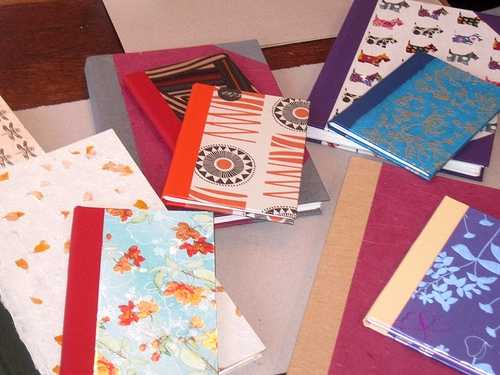
Another brilliant workshop at The Garden House – last Saturday a small group of us settled in to enjoy a completely absorbing few hours learning the basic steps of book binding by making our own single section notebook and a multiple section, stitched, case bound sketchbook.
When you’re more used to days spent juggling work, children, shopping – the practical stuff of life! – what could be better than escaping all that for the pleasures of wrapping paper, PVA glue, paintbrushes, linen thread and linen tape and mull (Blue Peter comes to mind!)…
The workshop was led by the very knowledgeable Brighton-based paper maker and book binder Nicola Jackson who patiently took us stage by stage through the basic steps of this most traditional craft.
Precision needed, deft expertise and creativity, but nonetheless a very accessible craft and so inspiring to create a useful, professional and beautiful object out of these simple materials.
We all envisaged how we could use hand-made and personalized books – as festive gifts, personalized with photos or postcards, special papers or ribbons added – maybe for memories, poems, or garden notes and sketches…
It was so very enjoyable to spend a delightful day in good company, be served a delicious home-made lunch and wine (!) – and then to take home two uniquely crafted books – we all loved it!
Mistletoe Market at The Garden House
Posted by editor on Sunday, 13 November 2011
MARK THE DATE! Saturday 26 November, 12 – 5pm. Come and buy your Christmas presents while enjoying home-made food, lunches and teas, mulled wine and festive delights as well as carol singing.
- yummy Christmas breads, cakes and preserves
- beautiful plants, bulbs and seeds
- marvelous mosaics
- gorgeous knits
- stunning jewellery
- amazing art
- stylish ceramics
- hand-crafted gifts for the gardener
And a whole lot more besides! Enjoy a wonderful festive afternoon – bring friends and family to The Garden House, 5 Warleigh Road, Brighton BN1 4NT
Our Favourite Plants for Dry Shade
Posted by editor on Thursday, 10 November 2011
Dry shade is one of the most difficult parts of the garden – here at the Garden House we are always being asked for advice on plants that will tolerate this situation.
All the plants that we are recommending come with the RHS Award of Garden Merit (AGM); that means that they have been tried and tested and have come out well thriving in dry shade conditions.
They will all need lots of watering in their first season to settle them in and you can also help by mulching well with compost and manure or bark chippings. You can even plant through cardboard – water well first to make it more flexible and then using a knife, cut holes in the cardboard for planting through. Cover with bark mulch to weigh the cardboard down and to make it look more attractive.
Our favourite dry shade plants:
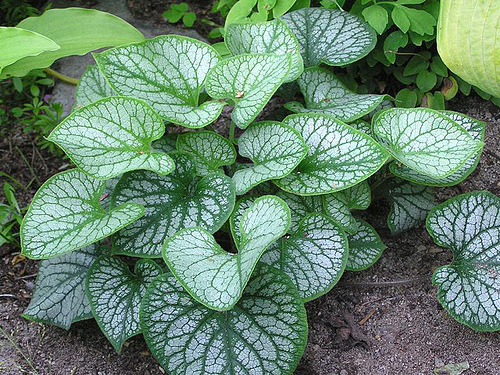
Brunnera macrophylla – a member of the borage and comfrey family, it is a really good weed suppressant. It has rather rough, heart-shaped leaves above tough, slowly spreading roots – the effect is rather like a rough-textured hosta, but unlike hostas doesn’t get eaten by slugs and snails! Known as the perennial forget-me-not, it produces very dainty pale blue flowers. The silver form called ‘Jack Frost’ really lights up a shady corner and is lovely cultivar. Height 45cm (18in)
Dryopteris filix-mas - I’m always surprised that this plant is tolerant of dry, shady conditions. If like me you have problems remembering what fern goes where, the clue is in the name DRYopteris! It is known as the shuttlecock fern and once established, its finely dissected widely splayed fronds make a really good contrast to broader foliage. You have to wait for a while for it to reach maturity but it is worth the wait. Two favourite AGM cultivars are ‘Cristata’ and ‘Grandiceps Wills’ – both have crests at the tips of their fronds and of their leaf divisions. Height 1m (39in)
Euonymus fortunei ‘Emerald ‘n’ Gold’ – the poor old Euonymus always seems to get a bad press – maybe because it is often used in places where it doesn’t get looked after very well. It is a great winter plant and when the cold gets to it the small dark leaves, edged in gold, develop a lovely pink tinge. It can be pruned hard in spring and clipped to shape, or if left will also climb walls. It also looks good in containers in a shady position. Height 50cm (20in)
Epimedium x perralchicum – evergreen epimediums, commonly known as bishop’s mitre, are good in dry shade, this one makes a dense clump. This form was found at Wisley, RHS gardens in the 1930s. It is in the same family as Berberis and Mahonia, and has the same yellow roots as these two cousins. In spring sprays of very dainty, dancing, pale yellow flowers cover the foliage. It makes a good weed-smothering hardy perennial cover which is attractive all year. Height 40cm (16in)
Narcissus ‘Jack Snipe’ – now is bulb planting time and some of the small narcissi are brilliant in dry shade. ‘Jack Snipe’ has strong stems and small flowers and look great gown in clumps, add plenty of compost before planting to give them a good start.
Geranium macrorrhizum ‘White-Ness’ – this is a lovely cultivar of the hardy geranium. It has a very interesting aroma, also has rather good autumn colour – and it is sometimes evergreen here in Brighton! It flowers May and June when it’s white flowers light up the shade, it’s a really good form. Height 30cm (12in)
Lamium maculatum ‘Ghost’ – such lovely plant, its green-edged silvery foliage really catches the eye so ideal for dry shade. This is a very vigorous growing form. Height 30cm (12in)
Iris foetidissima – the ‘stinking iris’ is a great perennial for tough situations (fear not, it only smells when you crush the leaves!). The heavy-duty long grass-like evergreen foliage is a good feature, and although the flowers are not terribly exciting I love the orange fruits, held in fat pods, that appear in autumn and last for ages. Height 45cm (18in)
Vinca minor ‘Argenteovariegata’ - I love Vinca, its windmill-like flowers are very delicate and it comes in so many different colours and forms. Great for suppressing weeds as it forms a very dense carpet. If you cut it back in March with shears it will produce lots of flowers on the side shoots. It often tends to get neglected but with care it will produce some lovely pale purple flowers in spring, and the leaves are evergreen. Height 10cm (4in) NOTE: Vinca major is best left to larger gardens as it can be quite invasive!
The virtual world meets your garden!
Posted by editor on Friday, 4 November 2011
As keen iPhone users we’ve been doing some research into just a few of the garden-related apps out there. There are literally thousands, most not that good, many US-centric, some are free though undoubtedly the better apps do cost. Below are just a few recommendations – if you have any other apps that you find useful, do let us know!
Top of our list is the RHS Grow Your Own iPhone app designed to help you choose and grow fruit and vegetables – however much space or time you have. The base application is free and covers the 20 most popular varieties of fruit and veg. You can buy additional content bundles to extend the content of the app (£1.79 each). We think this is a superb and very useful resource when you’re perhaps visiting a garden or don’t have your veg books to hand.
Also useful for the vegetable garden is Garden Planner v1.8 (£2.49) – this gives you the ability to add your own produce to the app and also add this produce to the plot planner, my garden and favourites functions.
Landscaper’s Companion (£2.99) boasts over 9,000 photos, 16 plant categories – it is somewhat US-centric, though still very useful for a UK garden. You can view information such as water usage, size, and sun requirements. Most have a short description of the plant along with cultivation information, common uses, and any problems they may have. Each plant entry includes beautiful pictures, or you can add your own picture to each plant.
Garden House friend Steve B recommends Garden Journal (£0.69) – it’s a great on-the-go app for capturing photos and essential data as a garden visit or trip unfolds. Or use it to quickly track your garden as each season evolves, making notes as you go. When your journal entry is complete you can save it on your iPhone or you email your entries, along with the attached photo, to anyone you would like to share the moment with.
Another Garden House friend, Maggie L, recommends TreeId (£2.39). This app is listed in BBC Countryfile’s top 10 apps, and is a comprehensive field guide to identifying trees found growing in the open countryside and natural woodland of the British Isles. All species native to the British Isles are covered, also naturalised species. Listings include data on family, genus, status, distribution, ecological value, location, soil preference, timber, firewood, diseases, medicinal and other uses.
If you want to find out details over 2,000 plants and see more than 9.500 colour pictures then the Botany Buddy Tree & Shrub Finder (£6.99) could be the app for you. It is pretty expensive but the interface is very slick and the whole thing is well presented. Apart from the price, the only drawback you might find is that the plants are US oriented, although having said that you should find most of the ones you are looking at even if you prefer native UK plants.
The Collins British Wildlife Photoguide (£5.99) is an interactive version of the popular Collins Complete British Wildlife Photoguide. This easy-to-use guide features more than 1500 species most likely to be encountered (with photo images and text descriptions). 16 categories include birds, amphibians, spiders, wild flowers and fungi.
And finally, Bird of Britain and Ireland (£12.99) – equal parts wildlife guide and feel-good pick-me-up, it features comprehensive information on 271 species of birds, including illustrations and photographs, info on typical behavior, quick searches – and wonderfully, audio recordings of both songs and calls.