Archive for December, 2011

Last thoughts on the past week’s Christmas festivities…

Posted by editor on Tuesday, 27 December 2011

Before we welcome in the New Year (and we’re so looking forward to it, we’ve so much going on!) – a final view on Christmas from all of us here – the words of  Pam Ayres, as ever, amusing, dry and so so right…

Goodwill To Men – Give Us Your Money by Pam Ayres

It was Christmas Eve on a Friday

The shops was full of cheer,

With tinsel in the windows,

And presents twice as dear.

A thousand Father Christmases,

Sat in their little huts,

And folk was buying crackers

And folk was buying nuts.

All up and down the country,

Before the light was snuffed,

Turkeys they get murdered,

And cockerels they got stuffed,

Christmas cakes got marzipanned,

And puddin’s they got steamed

Mothers they got desperate

And tired kiddies screamed.

Hundredweight’s of Christmas cards,

Went flying through the post,

With first class postage stamps on those,

You had to flatter most.

Within a million kitchens,

Mince pies was being made,

On everyone’s radio,

“White Christmas”, it was played.

Out in the frozen countryside

Men crept round on their own,

Hacking off the holly,

What other folks had grown,

Mistletoe on willow trees,

Was by a man wrenched clear,

So he could kiss his neighbour’s wife,

He’d fancied all the year.

And out upon the hillside,

Where the Christmas trees had stood,

All was completely barren,

But for little stumps of wood,

The little trees that flourished

All the year were there no more,

But in a million houses,

Dropped their needles on the floor.

And out of every cranny, cupboard,

Hiding place and nook,

Little bikes and kiddies’ trikes,

Were secretively took,

Yards of wrapping paper,

Was rustled round about,

And bikes were wheeled to bedrooms,

With the pedals sticking out.

Rolled up in Christmas paper

The Action Men were tensed,

All ready for the morning,

When their fighting life commenced,

With tommy guns and daggers,

All clustered round about,

“Peace on Earth – Goodwill to Men”

The figures seemed to shout.

The church was standing empty,

The pub was standing packed,

There came a yell, “Noel, Noel!”

And glasses they got cracked.

From up above the fireplace,

Christmas cards began to fall,

And trodden on the floor, said:

“Merry Christmas, to you all.”

Our favourite Savoury Nut Roast!

Posted by editor on Thursday, 22 December 2011

Although it may seem almost a cliché, here at The Garden House we love a savoury nut roast at Christmas!  Some of us are vegetarian, some are not – but everyone seems to enjoy this tried-and-tested favourite!

Ingredients:

  • 250gms (8oz) ground mixed nuts
  • 250gms (8oz) fresh wholemeal bread crumbs
  • 125gms (4oz) finely chopped onion
  • 2 tablespoons olive or sunflower oil
  • 2 eggs, beaten
  • Salt and freshly milled black pepper
  • 1 – 2 cloves of garlic, peeled and finely chopped
  • 1 – 2 teaspoons of yeast extract
  • 1/2 – 1 teaspoon of finely chopped thyme
  • 1/2 – 1 teaspoon of finely chopped parsley
  • 125gms (4 oz) grated Edam or Cheddar cheese

Set the oven at 180c (350f) Gas 4.

Mix the nuts and bread crumbs together in a bowl.  We use a food processor to grind the nuts and make the bread crumbs, it is a good idea to add the parsley and thyme to the processor at the same time, to save you chopping them by hand.

Saute the onion and garlic until soft but not browned, and then add this to the nuts and bread crumbs.

Beat up the eggs again, and add them, together with the yeast extract, and a couple of tablespoons of water, salt and pepper and grated cheese to the nut mix.

Leave to stand for 15 minutes and then shape into a roll about 15cm or 6″ long and place it on a well oiled baking tray.

Bake in a pre-heated oven for 30-45 minutes until firm and golden brown.

Serve with a selection of seasonal vegetables and a red wine sauce.

Happy Christmas and enjoy!


The holly and the ivy…

Posted by editor on Wednesday, 21 December 2011

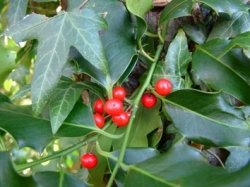
Both holly and ivy make striking winter evergreens with all the traditional Christmas links.

Hollies carry colourful winter berries to add to their important all-year-round foliage, especially attractive when you consider that from October to March most other plants have shut down for the winter. They are very tough and grow well in inhospitable conditions such as windy and salty areas. Many have very attractive foliage, and of course, holly berries are a favourite with birds and other wildlife and last really well when cut for decoration.

Here are three hollies that are recommended by the RHS. Don’t forget it is the females that produce the berries, though in most cases you need a male nearby to produce berries (this means that the plant is dioecious – male and female flowers on separate plants). There are some hollies that do not need a male and female – J.C. van Tol being an example of this – so be sure to check them out with the nursery before buying. Just to make things even more complicated some hollies have a male name but are female or visa versa!  See below Ilex x altaclerensis ‘Golden King’.

Ilex x altaclerensis ‘Golden King’: despite its name, ‘Golden King’ is a female holly with a crowded crop of slightly brownish red berries set amongst colourful leaves. Purple stems carry almost spine-free foliage with wide bright yellow margins making ‘Golden King’ one of the most colourful of all garden shrubs. Vigorous, but easily clipped to a hedge if required. 1.8m (6ft)

Ilex aquifolium ‘Handsworth New Silver’:  rich purple young growth carries long, rather narrow, brightly variegated leaves with a little central mottling and a broad margin of pale cream or white. One of the more prolific hollies, with its crop of bright red berries which make a striking contrast with the foliage, ‘Handsworth New Silver’ eventually makes a bold and impressive specimen. 1.6m (5ft)

Ilex x altaclerensis ‘Lawsoniana’:  one of the brightest of all hollies, the large and almost spine-free foliage is vividly splashed with bright yellow and pale green across the centre of each leaf. The berries are brownish red and carried in generous clusters along the branches. Rather upright in growth, branches with all-green foliage may sometimes appear but these are easily cut out. 1.8m (6ft)

The botanical name for the ivy family is Hedera. Ivies are hardy, evergreen, clinging, climbing plants, ideal for growing up walls, over tree stumps or for ground cover. They can be grown in pots, hanging baskets, window boxes and used as houseplants. Hederas are a very useful group of plants for the garden. The wide range of varieties now available give colour and form all the year round. See Fibrex nursery for a fantastic collection www.fibrex.co.uk  Here are some recommended by the RHS:

Hedera helix ‘Parsley Crested’:  a distinctive, brightly coloured, all-green ivy with pale, fairly prominent veins – the main feature of ‘Parsley Crested’ is these tightly waved leaf margins. The surface of the leaf may also be puckered or waved and the result is an attractive and intriguing plant that produces long trails so is ideal for cutting for the holidays or in baskets. 2m (61/2ft)

Hedera colchica ‘Sulphur Heart’:  also known, incorrectly, as ‘Paddy’s Pride’, this is softer in its colouring than ‘Dentata Variegata’ and with smaller, 10-12.5cm (4-5in), foliage. Each leaf rolls back a little at the sides highlighting the irregular bright yellow central splash, which fades with age, surrounded by a pale green outer zone. Good on walls or fences, or as ground cover. 3m (10ft)

Hedera helix ‘Glacier’:  one of the most popular of all ivies, ‘Glacier’ is widely used both indoors as a house plant and outside. It is a superb ground cover ivy, even in dry and shady situations, and is also good on dark walls. Its silvery-grey mottling and slender cream edging to the three-lobed leaves bring new brightness to shady areas. 3m (10ft)

Creating your own festive highlights…

Posted by editor on Monday, 12 December 2011

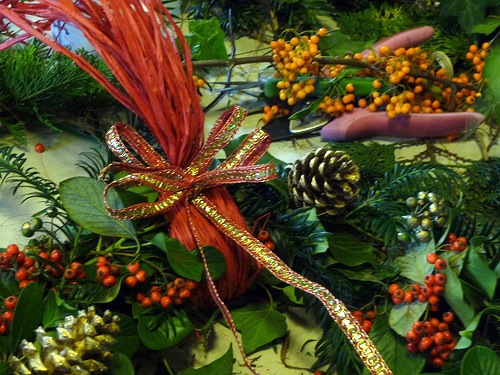
Making our own gifts, Christmas cards and festive wreaths can add that bit more cheer to this time of the year.  Recent workshops at The Garden House have included Book Binding with Nicola Jackson, Paper Collage with Jane Robbins, and recently, wreath-making classes with Deborah Kalinke – it’s been a whirlwind of creativity (even for those who mistakenly think they don’t have a creative bone in their body!).

And what’s more, these crafts are all about recycling, using what’s to hand – an ethos that is very important to us.  Smallish pieces of leftover wrapping paper can be employed as beautiful note- or sketch-book covers (customized to suit a gardening friend, poetry lover or travelling artist), scraps of newspaper (The Guardian is Jane’s favourite) are snipped into delightful collaged artworks – and of course, fresh foliage, sumptuous berries and cones from the garden create the most bountiful of decorative wreaths.


Again we collaborated with the wonderful Much Ado Books in Alfriston for two of our wreath-making workshops.  Alfriston is a picture-perfect Sussex village, with Much Ado Books at its heart.  This very special bookshop offers both new and second-hand books and owners Nash and Cate are always on hand to give recommendations.  It is well worth a visit at any time, especially if you combine with tea at the renowned Badgers Tearooms just around the corner (scribbled on one wall: “love and scandal are the best sweeteners of tea”.  Love it)…

Next year we have another exciting and diverse programme of workshops, courses and garden visits lined up, starting mid-January with Making a Bag or Cushion and Next Steps in Knitting (cosy, indoory activities!). For the more horticulture minded, our 16-session Principles of Horticulture, and 8-week Intermediate Gardener courses both start in February.

We’ve also lined up a visit to the wonderful winter garden at Cambridge University Botanic Gardens in mid-February. All great ways to prepare for the new gardening year!

Gifts for Gardeners…

Posted by editor on Wednesday, 7 December 2011

I rather like this month – the pressure is off!  A bit of fireside gardening is lovely at this time of year – although it has still been very mild here in Brighton.  Gardening in your head or on paper can be very enjoyable and you can certainly get carried away with thinking of exciting projects for the spring.

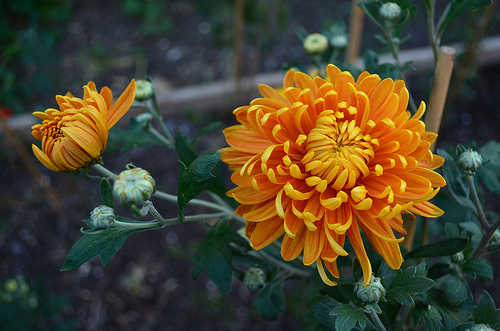
Spend time on the winters evenings planning and looking through the seed and bulb catalogues – I love this job! – it is great to make notes of the things you want to grow – what was successful last year and which specialist group of plants you may want to try your hand at growing.  For example, dahlias or chrysanthemums. See www.hallsofheddon.co.uk for a really comprehensive list of dahlias and chrysanthemums.

Get your orders for seeds in early to avoid the Christmas post and to ensure your selections are available – see Chilterns Seeds www.chilternseeds.co.uk, Nicky’s Nursery www.nickys-nursery.co.uk or  The Real Seed Catalogue www.realseeds.co.uk and here at The Garden House we also has a great selection, see our  SHOP section on this website.

Some other great gift ideas for your gardening friends:

Secateurs – you can get a reasonable pair for £15, or, if you are really trying to impress someone, buy Felcoswww.worldoffelco.co.uk  – and how about a sharpening stone to go with them?

Pocket knife - for taking cuttings and slicing open sacks of compost. We love the Felco Victorinox General Purpose Knife from World of Felco www.worldoffelco.co.uk or Harrod Horticultural www.harrodhorticultural.com

Hand tools – there are many really good ranges around – try a long handled fork and trowel from Quality Garden Tools www.qualitygardentools.com or Sneeboer tools are very special and a real investment that is going to last www.sneeboer.com

Labelling systemsLabels ‘N’ Things do some wonderful black labels that are long lasting and you can write on them with a white pen which will withstand all weathers and can be recycled by cleaning with white spirit www.labelsnthings.co.uk

Trugs - are a must and tubtrugs make a brilliant present, especially if filled with other lovely gardening items such as seeds and books or plants and a small bag of compost.  You can buy these from Amazon or www.tubtrugs.com

Or how about one of our  Garden House Vouchers for a very special workshop or garden visit?  We will be visiting the Cambridge Botanic Gardens in February – join us for a truly magical experience! Definitely something to look forward to in February and a great gift for a friend – see our DIARY for more details of this and many other courses, workshops or garden visits.

Finally, there’s a wealth of great gardening books out there, guaranteed to give pleasure to any gardener.  Anything by the RHS is always good, or a year book of “what to do in the garden each month” is always really useful.  A plant identification book is always helpful too.  The Garden House plan to recommend books to buy from Amazon in the New Year so watch this space!

So for all your gardening friends and family, lots of ideas and time to get shopping!

Plant of the Month: Viburnum x bodnantense ‘Dawn’

Posted by editor on Monday, 5 December 2011

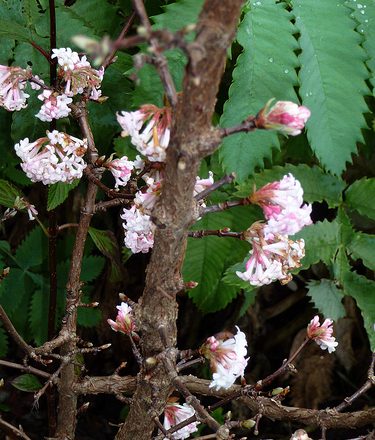
The winter flowering Viburnum, Viburnum x bodnantense ‘Dawn’, is a real beauty and is a must for this time of year.  It has pale pink tubular flowers with an exquisite fragrance and a really long flowering period.

It belongs to the Caprifoliaceae family, the same family as honeysuckle, and has a height and spread of 3m x 2m (10ft by 6ft) and is a long-lived, upright, deciduous shrub, which prefers a moist, well drained soil but will tolerate chalk as well.

The genus Viburnum contains about 150 evergreen and deciduous shrubs and small trees, mainly from wooded areas of northern temperate regions, but extending to Malaysia and South America.

Different viburnums are grown for their flowers, fruit and foliage. Most have white flowers, some of them very fragrant, and brightly coloured fruits. Viburnum x bodnantense is grown for its fragrant, pretty, pink winter blossom, while others produce beautiful, scented flowers in spring or early summer.

The fruits of Viburnum are usually small and spherical, and usually black, blue or red, but V. opulus ‘Xanthocarpum’, a cultivar of the guelder rose, bears bright yellow berries.

V. x bodnantense is the result of a cross between Viburnum farreri (formerly V. fragrans) and V. grandiflorum, and was bred at Bodnant gardens in Wales.

In mild spells it is a spectacular sight, very cheering on a winter’s day. The flowers are generally frost resistant, but even if they do get frosted, more soon open within a few days. Cut a few sprigs for the house – as cut flowers they last a long time.

Viburnums are excellent plants for a woodland garden or shrub border.  A sunny site is best, but it can also tolerate dappled shade – in too much shade it will just grow towards the light.  It is hardy throughout the British Isles.

As it flowers on bare stems, which is very attractive feature at this time of the year, it is best planted against a green background (such as hedging) to show off its beautiful clusters of flowers, or mixed in with other coloured stems. Alternatively, plant where the fragrance can be appreciated, beside a frequently used path.

If you have a deciduous Viburnum that is old and woody and not flowering well, then now is a good time to prune our a third of the older stems, right down to the base.  This will rejuvenate the plant and send up new shoots to flower next year.