Archive for February, 2012

We love: heavenly Hellebores

Posted by editor on Sunday, 26 February 2012

Hellebores (sometimes known as the Christmas or Lenten rose) are perennial garden plants with beautiful, elegant flowers. At the Garden House we have some wonderful varieties and we increase our stock by buying a couple of new ones every year.  We also collect the seeds and hope that one day we will have a cultivar that is worth naming!

Hellebores are brilliant for brightening up shady areas during late winter and early spring. Some species are grown for their striking evergreen architectural foliage such as H.foetidus and H.argutifolius. They also have a long flowering period so, although often expensive, they certainly earn their keep!

Hellebores prefer to grow in rich, well-drained soil in dappled shade. Avoid planting in very dry or waterlogged soil. Provide shelter from strong, cold winds. Try to plant them on high ground so that you can appreciate their flowers, which are often hanging down – the story being that when Christ passed the hellebores on his way to the cross they hung their heads in shame.  Much breeding work is being done to try to raise their heads so that we can enjoy their subtle and very elegant flowers!

These flowers are often hidden by the large leaves, so ensure they can be seen clearly by removing a few older leaves from the centre of the clump (traditionally this is a job that is supposed to be done on Boxing Day!).  At the same time remove any dead, diseased or damaged foliage that can harbour hellebore leaf spot, an unsightly fungal disease.  The other reason for exposing the flowers by removing the leaves is that this will also help insects to pollinate the flowers and ensure good seed set for new plants that can be propagated from the resulting seed.

Keep them well watered during dry spells and mulch them every year with leaf mould, chipped bark or other organic matter in autumn. This is really important, as with many plants that flower in the winter they can be neglected.  If they don’t produce many flowers apply pelleted chicken manure or fish blood and bone in the spring.  They make great container plants, but again don’t forget to feed them with a high potassium fertiliser such as Maxicrop to encourage flowering.

The best way to look after Hellebores is to cut the flowered stems to ground level for H.foetidua and H. argutifolius and with oriental hybrids deadhead them as with other perennials.

Buy Hellebores from Ashwood Nurseries www.ashwoodnurseries.com  – they specialize in raising many beautiful cultivars.  Our favourite way to display them is by cutting a few flowers and floating them facing upwards in water – a real February treat!

We love: the London Road Station Partnership

Posted by editor on Tuesday, 21 February 2012

We recently connected with a fantastic local initiative, the London Road Station Partnership – a group made up of neighbours living near the lovely nineteenth-century London Road station, just outside the centre of Brighton. Not only do we love them, we admire them too!

Through their local Residents’ Association (DRARA), these friends and neighbours got together with Southern Railway in April 2011 to set up a station community partnership. They now garden on two small plots on either side of the station building. In one, growing shade-tolerant ornamental plants and in the other, edible plants in raised beds.

The Garden House was delighted to contribute a couple of attractive planters to enhance the plot as it develops.  They even blogged about us!  Click here.

Meeting regularly to work on the gardens, usually on a TUESDAY between 3pm and 5.30pm, they’ve said they’d be delighted to welcome anybody who’s interested in community gardening, particularly if you live nearby.  To check out the daily Workdays diary of tasks, click here. 

The LRSP are also hoping to develop displays showing aspects of the history of London Road Station and residents’ memories of it.  To find our more or get involved, you can contact LRSP at lrsp@hotmail.co.uk or through their blog.

Often-used Horticulture Terms explained

Posted by editor on Saturday, 18 February 2012

Horticulture-speak can be a bit mystifying if you’re new to gardening and vegetable growing, so we thought we’d explain a few of the terms you’re most likely to come across:

Intercropping  - This growing method is where quick maturing plants are grown in between long-term crops – for example sow a row of radishes next to your parsnips, lettuces or spring onions in between rows of brassicas.

Catch cropping - This is when a quickly maturing crop is grown in the interval between harvesting one main crop and sowing or planting another. Suitable plants for this would be spring onions, radishes and lettuces.

Cut and come again - A range of leafy vegetables can be grown as ‘cut and come again’.  This term describes a method of harvesting the young leaves as-and-when when you need them.  Harvesting little and often prevents plants from maturing and ensures several harvests of small, tender, mild-flavoured leaves over a long period of time.  You can grow many of these all year round, although you may require a heated propagator, windowsill, greenhouse or polytunnel.  I like to grow ‘cut and come again’ leaves in the greenhouse in the winter so that they are available if you want a quick bowl of salad.

Amaranth, basil, beetroot, chicory, coriander, chard, corn salad, dandelion, endive, komatsuma, land cress, leaf celery, lettuce, mizuna, mustard, pak choi, parsley, purslane, radicchio, red kale, rocket, sorrel and spinach are all suitable and you can mix these together and grow them in polystyrene boxes if you have seed left over from the summer.

Vegetables usually grown for their roots such as beetroot, radish and turnip also have leaves that are tasty when harvested young.

Cropping squares - This is a method used to grow sweet corn. As the plants are wind pollinated they should be grown in blocks rather than rows, 45cm (18in) apart each way.

Successional sowing - This is a way of avoiding gluts and shortages of produce. By planning and sowing seed little and often in batches, it is possible to ensure plants are ready to harvest in succession throughout the growing period.  Quick-maturing vegetables, including carrots, French beans, peas, salads and spinach, are best sown regularly in small batches. This will produce a continuous, fresh supply of these crops.  For plants that are prone to bolting, such as coriander, rocket and spinach, successional sowing is especially crucial.

You may choose to grow some longer-fruiting crops such as courgettes, cucumbers, runner beans and sweetcorn in two batches to ensure you have plants well into autumn.  Choose a assortment of cultivars for nonstop cropping. Quick-maturing ones such as lettuce ‘Little Gem’ and carrot ‘Adelaide’ are ideal for successional sowings, but later-maturing, main-crop cultivars are also useful and, once mature, often remain in good condition for longer. Successional sowings are usually made at fortnightly intervals, but this may vary depending on environmental conditions. In practice, this means that lettuce may only need to be sown every three weeks in early spring, increasing to once a week in warm, and moist summer weather.

Plants that do not need to be successionally sown include those which produce fruits over a long period such as aubergines, peppers and tomatoes; those which store well, such as onions and pumpkins; and winter vegetables such as Brussels sprouts and leeks that need a long season to mature and can then be left in the ground to be picked in stages.

Earthing-up - The drawing up of soil around plants, usually with a draw hoe or drag fork. It is carried out on potato crops to prevent greening of tubers and blight infection; also used on brassicas to prevent wind-rock, on leeks and celery to blanch the stems, and in layering and stooling of fruit-tree rootstocks, to encourage the formation of roots on the earthed-up shoots.

Cloche - A low portable unit constructed of glass or rigid-plastic panes on a wire frame; used for the protection of plants and to advance growth. The term is also applied to plastic film stretched over wire hoops, a construction alternative known as a low continuous polythene tunnel.

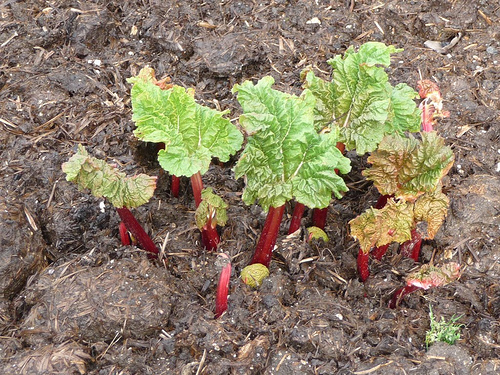
Forcing - Forcing is a method by which a plant’s leafy growth, flowering or fruiting is speeded up using a change of temperature and exclusion of light to encourage or ‘force’ the plant into growth. In the case of rhubarb or chicory this entails covering the bulbs or crowns with a large pot, dustbin or decorative rhubarb forcer. Plug any holes to exclude light.

Commercial forcing is carried out in specially designed greenhouses or sheds, often with additional bottom heat. In the domestic garden forcing is usually improvised in greenhouses and frames, or achieved with the use of forcing pots to cover individual plants.

Specially prepared bulbs, such as hyacinths, can be forced to provide a steady supply of bulb flowers from late December through April. The bulbs must be planted and kept in a cold dark place until the first signs of growth.

Heeling in - If you don’t have time to plant your bare-rooted shrubs or trees immediately it is perfectly safe to ‘heel them in’ until you have time to deal with them. Remove any packaging and soak the roots of the plant in water for several hours, dig a trench that is deep and wide enough to accommodate the roots of the plant. After you dig the trench, lay the plant in the trench with the plant at an angle so that the canopy is just above the trench and the roots are in the trench.  Fill in the trench and if necessary apply a mulch.

Soil improver - Any substance dug in to improve soil structure. This is generally organic matter, such as farmyard manure, garden compost, mushroom compost or leaf mould, but could be an inert substance such as lime or gypsum.

Plant of the Month: Pulmonaria

Posted by editor on Tuesday, 14 February 2012

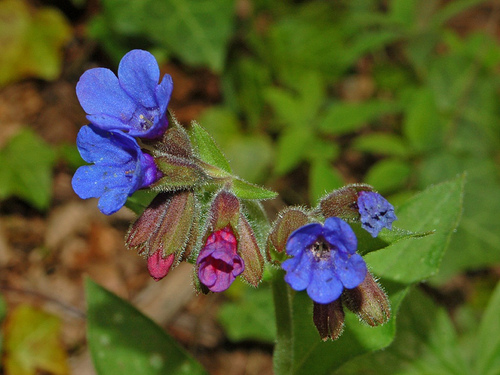
We are all eagerly awaiting the first herbaceous perennials of the year and the Pulmonarias always come up trumps! Pulmonaria rubra AGM (Award of Garden Merit) is always the first to flower, and needs to be observed at close quarters to see how lovely it is.

Pulmonarias are members of the borage family, (Boraginaceae). Along with their cousins, comfrey, borage, brunnera, forget-me-nots and anchusa, pulmonarias have hairy leaves and small funnel-shaped flowers.  The common name is lungwort – The name Pulmonaria comes from the Latin ‘pulmo’, the lung. The plant was considered to be an effective remedy for diseases of the lung because the spotted leaves were supposed to resemble diseased lungs.

Pulmonarias are evergreen perennials and thrive in humus-rich, moist but not waterlogged soil and do well in full or partial shade, which is an added bonus. They make brilliant ground cover plants in woodland or at the front of a border and the bees love them!  They are very hardy. Height & spread of up to 40cm (16in) x 90cm (36in)

The leaves are hairy and often spotted with white or silver. The leaves that develop after flowering have the best markings. Flowers can be pink, red, violet, purple, blue or white. They are funnel-shaped, 5-10mm (0.25 – 0.5in) across with 5 petals.

  • ‘Redstart’ has coral-red flowers and is often the first Pulmonaria to flower in midwinter. ‘Barfield Pink’ has pink and white striped flowers and grows up to a height of 30cm (12in).
  • P. r. var. albocorollata syn. alba has white flowers and ‘David Ward’ has white-variegated, sage-green leaves with cream margins and coral-red flowers. Both reach a height of 30cm (12in).
  • ‘Bowles’s Red’, developed by Edward Bowles, has coral-red flowers and leaves faintly spotted pale green. It grows to 30cm (12in) and is similar to ‘Redstart. Remove old leaves after flowering and divide every 3 – 5 years.

To propagate Pulmonarias, divide plants in autumn or after flowering or take root cuttings in mid-winter. Powdery mildew may be a problem in dry conditions and slugs and snails may damage new growth – but don’t let this put you off, they are super-useful plants to have in the garden!


Valentine’s Day, and thinking of roses…

Posted by editor on Saturday, 11 February 2012

Here at The Garden House we have many lovely roses – climbers, shrubs, ramblers, miniatures – we’re passionate about them!  But we also know that roses carry a certain mystique with regard to care – when to prune, how to prune, when to feed, with what etc…

If you know someone who would love to know more about roses and their care, why not buy them a Garden House Voucher (£10 upwards)?  The Voucher can be put towards any workshop, course or garden visit – but would be especially appropriate right now put towards our “All You Need to Know About Roses” workshop, taking place Saturday 2 June. The workshop will be led by rose expert Simon White of Peter Beales nursery in Norfolk. www.classicroses.co.uk

Contact us now and we can email a voucher to you before the 14th…!

If you’re thinking of planting some new roses this spring, remember that, as with all plants, it is so important to consider ‘right plant, right place’ – below is a list of some of our favourites:

Climbers for north-facing walls:

R. ‘Alberic Barbier’ AGM (Climber/Rambler). Flowers rich cream, apple fragrance, some repeat flowering, some winter leaf persistence. Ht 6m (20ft).

R. ‘Dortmund’ AGM (Climber). Single, blood-red flowers; repeat-flowering. Ht 2m (6½ft).

R. ‘Félicité Perpétue’ AGM (Climber/Rambler). White flowers, buds tinged red, some winter leaf persistence. Ht 5m (17ft).

Very vigorous roses for climbing into trees:

R. filipes ‘Kiftsgate’ AGM (Rambler). Slightly fragrant; one flowering period; creamy white flowers. Ht10m (30ft).

R. longicuspis (Climber). Slightly fragrant; one flowering period; white flowers; semi-evergreen, tender. Ht 6m (20ft).

R. ‘Seagull’ AGM (Climber/rambler). Slightly fragrant; one flowering period; white flowers with golden stamens. Ht 4.5m (15ft).

Roses for training up pillars: (Need to be flexible-stemmed, produce flowers at the ends of all current seasons growth, and preferably be of moderate vigour.)

R. ‘Compassion’ AGM (Climber/Rambler). Double, fragrant, repeat flowering; pink, shaded apricot blooms. Ht 2.4m (8ft)

R. ‘Danse de Feu’ (Climber) Double; repeat flowering; orange to scarlet flowers. Ht 2.4m (8ft)

R. ‘Golden Showers’ AGM (Climber/Rambler). Double; fragrant; repeat flowering; golden yellow blooms. Ht 2.1m (7ft).

Patio climbers are useful for smaller structures up to 3m (10ft) or so high: In a sunny spot, try pale cream, pink-tinged ‘Penny Lane’ (‘Hardwell’), or mauve-pink, heavily-scented ‘Gertrude Jekyll’ (‘Ausbord’).

Roses with ornamental foliage:

R. ‘Highdownensis’. Large, single crimson flowers, ferny leaves. Ht 3m (10ft).

R. multibracteata. Pink, single flowers; neat rounded leaflets. Ht 3m (10ft).

R. primula AGM. Pale, small, yellow flowers; shiny aromatic leaves; one flowering period. Ht 1.8m (6ft).

R.  sericea var. pteracantha. Red thorns; creamy-white flowers; small ferny leaves. Ht 2.4m (6ft).

Some roses suitable for hedges:

R. ‘Cornelia’ AGM. Double, fragrant apricot pink blooms. Repeat flowering. Ht 1.5m (5ft)

R. ‘Roseraie de l’ Hay’ AGM. Double, fragrant wine red blooms. Repeat flowering. Ht 2.1m (7ft).

R. ‘Zéphirine Drouhin’. Semi-double, fragrant carmine pink flowers. Thornless and repeat flowering. Ht 3m (10ft).

Roses with very decorative autumn hips:

R. ‘Fru Dagmar Hastrup’ AGM. Silvery pink single flowers; large red fruit. Ht 90cm (3ft).

R. rubrifolia.  Pink flowers once a year; scarlet globular hips. Ht 2.1m (7ft).

R. rugosa. Cerise or white flowers once a year; scarlet globular hips. Ht 1.8m (6ft).

Roses for ground cover:

R. ‘Nozomi’ AGM. Single pink flowers; one flowering period. Ht 30cm (1ft) and spread 1.5m (5ft).

R. Snow Carpet ‘Maccarpe’ Single, double white flowers throughout summer. Ht 15cm (6in) and spread 90cm (3ft).

R. Surrey = ’Korlanum’AGM. Double pink blooms from early summer until late autumn. Ht 60–90cm (2-3ft) and spread 90cm-1.2m (3-4ft).


Don’t forget to feed the birds!

Posted by editor on Monday, 6 February 2012

In the autumn and winter, it is a hard job for birds in the garden to find enough food.  There’s less food available, and less time to find it because of the shorter daylight hours.  Yet because farmers harvest their crops more efficiently (leaving less pickings in the field) and more quickly (leaving less ripe crops out for the birds) birds need more.

If you want birds in your garden all year round make sure you have some late fruit such as crab apples, cotoneaster or pyracantha.  Or, cook up these nutritious bird cakes:

  • 8oz of solid white vegetable fat
  • 1 cup of oatmeal
  • 1 cup of chopped nuts
  • 1 cup of flaked maize
  • I cup of kibbled wheat
  • 1 cup of mixed bird seed
  • I cup of vine fruits, chopped, or 6 cups of ready-made wild bird seed mix

Gently melt the fat in a large pan.  Place the dry ingredients into a large bowl and pour the fat over them.  Stir the mixture until the fat is well mixed in.  You will need sufficient fat to hold the dry ingredients together as the fat begins to cool.  With damp hands,pat the mixture into small cakes and leave to set in a cool place.

This extract taken from the Gardener’s Pocket Companion, edited by Vicky Bamforth


Enjoy a seedy weekend!

Posted by editor on Thursday, 2 February 2012

Seedy Sundays now include Seedy Saturdays too and are attracting more and more people. Primarily the event is about swapping seeds but they have grown and now make for a great family day out with workshops for adults and children and the opportunity to meet people interested in gardening, local food production, climate change and sustainability.

Lewes: Saturday 4 February 10am-3pm at Lewes Town Hall. Free for children, 50p for adults. All day workshops include: making paper plant pots, willow weaving, bug trays, children’s craft and art workshop – and lots more. www.lewes.gov.uk/business/9729.asp

Lewes talks include:

  • 10.30 – Brighton Permaculture Trust
  • 11am – James Greyson, making a Biochar cooker for soil improver while brewing a cup of tea
  • 11.45 – Millennium Seed Bank, Kew at Wakehurst Place – practical talk about seeds
  • 12.30 – Peter May, Sussex Apples and Good Fruit Tree Health – bring photos of diseased branches to get accurate advice

Hove: Sunday 5 February 10am – 4.30pm at Hove Town Hall, Norton Road BN3 4AH. Free for children, £2 for adults. Come and enjoy more than 50 stalls, lots of talks, demonstrations and children’s activities as well as the community seed-swap.  Bring seeds to swap (in labelled envelopes, please) or make a 50p donation per packet. www.seedysunday.org 

Hove talks include:

  • 11am – Crop varieties – why do gardens matter?  Bob Sherman, Chief Horticultural Officer, Garden Organic
  • 11.40 – Seeds of Activism – campaigning for the seeds, agricultural biodiversity and food sovereignty of the world’s majority food providers.  Patrick Mulvany, Chair, UK Food Group
  • 12.15 – How to dry seeds from your garden and keep them alive. Vanessa Sutcliffe, Training Specialist, Millennium Seed Bank