Archive for December, 2010

From Christopher Lloyd’s ‘Cuttings’…

Posted by editor on Sunday, 26 December 2010

“No passionate gardener, even though distracted by the prospect of Christmas family gatherings, will have their minds totally divorced from what’s going on out there.  Where shall they get their inspiration? Of course, we rely on the successes of others – I do that myself – yet what we are offered of a practical nature is minimal.  So, the actual practice of gardening (taking cuttings, how to dig, how to prune, and suchlike) becomes increasingly neglected.  If teachers themselves are uninterested in practice, there will soon be no one to teach the skills required for good hands-on gardening, and they will atrophy and be lost.

There is, thank goodness, a public demand for these skills, yet the actual demonstration of them (in contrast to books about them, which are never so immediate), and the opportunity to try them out for oneself, is increasingly rare.

…when meeting examples of the new generation, I am sometimes enormously encouraged.  Genius and inspiration are inevitably in short supply, but those who have it keep coming along.  Some are passionate about plants from the start.

…but there are others, scarcely less valuable, who, having started off in the wrong direction and decided that the rat race is not for them, switch careers (at considerable material deprivation to themselves) and become passionate gardeners and careerists in gardening, when verging on middle age.  They bring to gardening an unstoppable dense of direction, intelligently applied.  And they keep coming along.

But the hands-on skills still need cherishing, their value recognised and rewarded as they deserve.” Taken from Christopher Lloyd’s book Cuttings (a wonderful book – a favourite of ours – full of musings, knowledge and marvellous insights into gardening at Great Dixter).

We at The Garden House wholeheartedly agree with Christopher Lloyd’s thinking – and will be running several courses in 2011 that teach practical gardening – fun, inspiring, hands-on and rich in horticultural knowledge!

  • Second Time Gardener 8-week course; starts 2 February
  • Garden DIY Workshop; 5 February
  • Garden Design with Peter Thurman; starts 7 February
  • First Time Gardener 10-week course; starts 21 March
  • Growing Vegetables 6-week course; starts 30 March

And there will be more hands-on courses and workshops throughout the year -  check in DIARY for more details!

Falling Snow: a favourite poem

Posted by editor on Tuesday, 21 December 2010

Falling Snow – by Alan Williams

See how they fall

An infinity of heavenly aspirations

Come to convert the world

With a deep and even purity.

Sent to nullify and cleanse

To enhance and beautify

To muffle and calm

With the tranquillity

Of a gossamer eiderdown.

To cloak in a mystery

Of endless variations

Of the same tonal theme;

Converting everything

To a glistening coalescence.

Tidying up the farmyard

Smoothing out the fields

Transmogrifying neglected gardens

Into dazzling showpieces,

Cluttered garden sheds

Into sparkling summer-houses,

Making abandoned bean sticks

As elegant as sculptured crystal,

And fondant death-traps

Of old familiar ponds

Enhancing the weary timothy

In the sad neglected churchyard.

Cheering up the stories

On the long forgotten grave stones.

Turning distant spires

Into alabaster space rockets

And drooping telephone lines

Into crystal mooring ropes

For ocean going bungalows.

The purification is complete, unblemished,

Save for the prints of wandering spirits

Fading in the gentle cascade.

Gardening Gifts for Christmas!

Posted by editor on Monday, 13 December 2010

We know it’s never that easy to rustle up the best gift for a keen gardener – another trowel, more twine, mmmm…well, this year we have the answer!

Garden House courses and workshops make the best gifts – consider buying a full course, or a voucher which your friend or partner can put towards any Garden House event.

We have a very exciting and varied programme for 2011, including:

  • First Time Gardener course (starts 17 January)
  • Learn to Knit workshop (22 January)
  • Make your own Marmalade workshop (29 January)
  • Garden DIY workshop (5 February)
  • Visit to the Winter Garden at Anglesey Abbey (12 February)
  • And many more – mosaics, hen keeping, creative plant staking, stone carving, pen and ink drawing, and how to grow vegetables…

Our 2010 course Garden Design with Peter Thurman was very successful, so successful in fact that we’re running it again (starting 7 February)!

We were delighted to receive great feedback: “Peter Thurman was excellent.  The group size was just right, not too big. Loved the day at Wisley, it was good to put the theory of the first week into a real situation and have someone explain the different planting styles to you. I think Wisley and the day on hard landscaping helped add variety to the course so each week wasn’t too similar”

So if you want to give a loved one (or yourself!) something they can enjoy in the weeks and months to come – do consider a Garden House gift…

Check the DIARY of this website for more details, and contact us at any time if you have questions – and have a Happy Christmas!

Plant of the month: Cornus sanguinea ‘Midwinter Fire’

Posted by editor on Friday, 10 December 2010

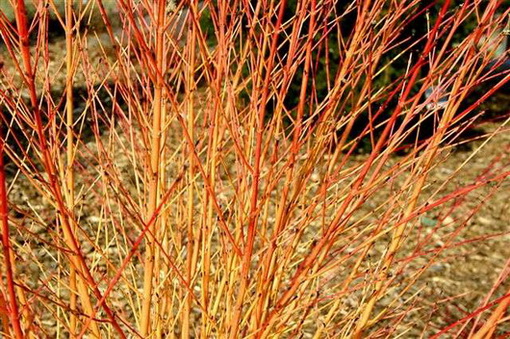
There are many shrubs that will add colour through these darker winter months, including dogwoods (Cornus) which, if pruned hard in the spring, produce fantastically coloured young stems the following winter as the leaves fall.

A great choice is Cornus sanguinea ‘Midwinter Fire’ which has rich orange, red and yellow stems and forms a thick, suckering shrub. This cultivar looks really vibrant wonderful on a clear sunny day.

  • Common name: Common dogwood, common cornel
  • Family: Cornaceae
  • Height & spread: Up to 1.5m x 0.8m
  • Form: Upright deciduous shrub
  • Soil: Tolerates a wide range of soils and locations, but prefers moist soil
  • Aspect: Full sun for best winter stem colour
  • Hardiness: Fully hardy to -15˚C (5F)

The original plant of this selection of Cornus sanguinea was discovered in a German garden by H. Venhorst in about 1980, but wasn’t named ‘Midwinter Fire’ until 1990.

It is a very robust shrub that spreads by suckering to fill spaces. Its winter colour is shown to greatest effect when grown in front of a dark background, also when grown with other colourful dogwoods with contrasting stem colours.

The young stems are a brilliant orange-yellow from autumn through to spring, with red tints on the sunnier sides of the stems. As the new leaves appear, the stems turn a yellow-green, bearing bright green leaves that can turn a brilliant yellow in autumn. White flowers, borne in dense flat cymes, are produced in summer followed by dull blue-black fruit.

Cultivation: Will grow in a wide range of soils and locations, but will give the best winter stem colour if grown in full sun. It is ideal for growing alongside a pond or stream as it prefers moister soils.

To maintain good winter stem colour, Cornus sanguinea ‘Midwinter Fire’ should be pruned down to 2-3 buds above the base in spring. To maintain a good framework only a third of the stems should be pruned each year, and these should be the oldest stems each time.

Propagation: Cornus sanguinea ‘Midwinter Fire’ is ideal for taking hardwood cuttings from in autumn.

To see this amazing plant in all its glory join us for our visit to Anglesey Abbey in February – see DIARY on this website for more info.

We love…Jan’s blog!

Posted by editor on Sunday, 5 December 2010

Jan M. is one of an enthusiastic group of women who regularly (every Friday!) gather to drink coffee, chat about the week’s events – and to work in the beautiful garden at The Garden House!

What better way to learn about horticulture and track each season’s living timetable.  For some that learning is then taken into their own garden or allotment, for others, with perhaps just window-boxes or patio spaces, it’s a wonderful opportunity to work physically, getting stuck in to whatever the garden needs doing that week.

From sowing seeds, harvesting spring-sown vegetables, digging in manure, pruning the rose arches, propagating hardwood cuttings, training raspberry bushes – to laying slab patios and creating mosaic features and pathways – there’s never a dull moment!

Jan’s blog – http://omaoilreanail.blogspot.com/ – tracks her reflections following retirement late 2009, what she calls “the first year of the rest of my life”…

We love her observations on life and new experiences– and she talks of working in The Garden House – her “retirement project no.4”!

Jan is also a passionate believer in permaculture – an ethos that combines three key aspects:

1. an ethical framework

2. understandings of how nature works, and

3. a design approach

This unique combination is then used to support the creation of sustainable, agriculturally productive, non-polluting and healthy settlements. In many places this means adapting our existing settlements. In other cases it can mean starting from scratch. Both offer interesting challenges and opportunities.

The word ‘permaculture’ comes from ‘permanent agriculture‘ and ‘permanent culture‘ – it is about living lightly on the planet, and making sure that we can sustain human activities for many generations to come, in harmony with nature. Permanence is not about everything staying the same. Its about stability, about deepening soils and cleaner water, thriving communities in self-reliant regions, biodiverse agriculture and social justice, peace and abundance.

One thing is for sure – it’s a fascinating subject, with many aspects, and it’s still evolving. NB this info taken from The Permaculture Assoc. website www.permaculture.org.uk

At The Garden House we so love energy and adventure – and Jan’s blog is all about both!

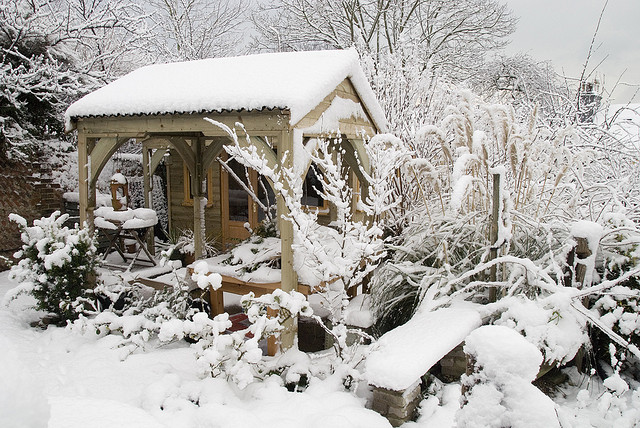
How to deal with a snowy garden!

Posted by editor on Thursday, 2 December 2010

When did we last have snow in early December?!  Last year it was January, the year before, April – this is becoming a regular if rather unpredictable occurrence!

So wonderful whilst it’s looking fresh, treacherous underfoot when it gets icy – and downright disaster for the garden if you didn’t prepare in good time (I didn’t!)…

On the plus side, it’s a great insulator, and it melts to provide much needed water to dry plants in the winter. However, heavy snow and ice build up can cause devastating damage in the garden if limbs and trunks bend or break. Even hardy plants and tough evergreens can also be damaged by prolonged spells of severe cold when soil becomes frozen.

To protect (I know too late this time, but worth remembering!):

  • Tie up plants: Before the snow, use plant netting to tie up the branches of your conifers and soft shrubs, to prevent them from being misshapen or broken by snow. Tie them in a cone shape, to deflect snow off to the sides.
  • Move containers: Put planters and containers under a shed or porch during snow and ice storms to keep freezing water from expanding and breaking containers.
  • Prevent your pond freezing over: Place a rubber ball in any outdoor ponds to prevent them icing over completely, then remove to allow oxygen into the water.

Post heavy snow:

  • Look after your garden birds: Don’t forget to put out extra food out, clearing snow and ice off bird-tables – and most important, fresh water – if possible de-ice your bird-baths and top up with fresh water.
  • Take care clearing paths: Be careful not to pile snow on your plants when clearing paths as it will then need to be removed and might do damage you can’t prevent.
  • Avoid Salt: Salt can damage lawns and plants when it runs off your driveway. If your plants have been exposed to salt, water and rinse them well as soon as temperatures are above freezing. Next time, use sand or clay-based kitty litter instead of salt.
  • Take care with damaged trees: Tender branches (particularly conifers) may become broken or weighed down with heavy snow. Broken branches should be pruned away immediately to prevent injury and disease. Ragged tears are very susceptible to infection, so remove damaged wood using clean cuts.
  • Remove snow from roofs (if you can safely): Remove the piles of snow that may cascade down onto your shrubs from the roof above. If your shrubs are right in the danger zone under a steep roof, you may want to protect them with a temporary wooden frame.
  • Keep off grass: Snow covered grass is fragile, easily uprooted, and susceptible to fungal diseases under the snow. Avoid walking on snow-covered grass as it will damage the turf beneath and leave unsightly marks on the lawn. 

Try to save damaged plants:

The extent of the damage often won’t be clear until spring, when you find out if your plant is able to spring back into shape. Wait for spring to do any staking or reshaping of bent plants, since winter branches are extremely brittle. In the spring they’ll be much more supple.

  • Cut back frosted growth in spring to a healthy, new bud, to prevent further die back and encourage plants to produce fresh, new shoots.
  • Feed damaged plants with a balanced fertiliser (one with equal amounts of Nitrogen, Phosphorus and Potassium) to encourage strong, healthy growth.
  • Dig up small, tender plants and take them into the greenhouse. Many will quickly produce new growth and recover, provided they are not subjected to prolonged periods of heavy frost, wet or cold.
  • Newly planted specimens will often lift themselves proud of the soil surface if there is a hard frost straight after planting. Check them regularly and re-firm the ground around them to ensure their roots are always in contact with the soil.

Finally – just enjoy the sheer beauty of your snowy gardenscape – take some photos and make a note in your September diary to have your own Christmas cards printed!