Archive for May, 2011
We love: Cleve West’s Best Show Garden, Chelsea Flower Show
Posted by editor on Saturday, 28 May 2011
Well, 2011′s Chelsea Flower Show extravaganza is over – the year’s inspirational kick-start for new gardening ideas, plantings and structures – we loved it!
Cleve West’s garden for The Daily Telegraph was awarded Best Show Garden – quite an accolade and well deserved, this was a beautiful garden and one of our favourites. We always expect the unexpected with Cleve’s gardens, yet they still have recognisable qualities – strong sculptural forms (last year remember those huge concrete planters? And the year before his dementia-friendly sensory garden with a giant sculptured ball at its centre?), moving water and sensitive planting.
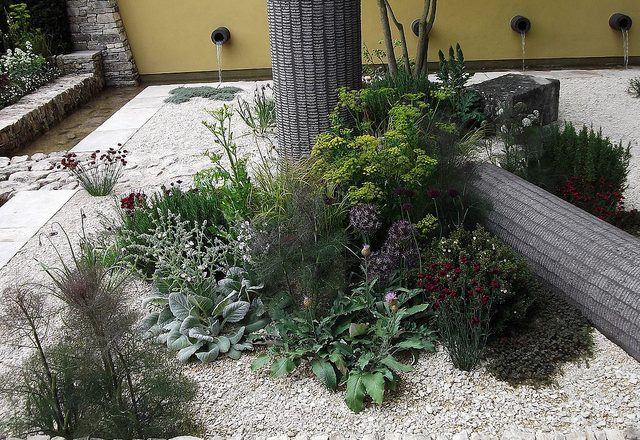
This year his garden’s warm off-yellow plastered and dry-stone walls and flowing water framed an open space containing three 10ft high columns by French artists Serge Bottagisio and Agnès Decoux, with one lying on the ground, that appeared to be ruins but in fact mix the old and new in concrete and terracotta. 
The planting looked so unconscious, almost self-seeded in effect, and the colouring exquisite – a soft blend of yellows, silvers and soft-whites – highlighted by the occasional dark red-pink Dianthus cruentus, grasses and airy umbellifers (including parsnip flowers from his own allotment!). Specimen trees of Styphnolobium japonicum (the Japanese pagoda tree), gave scale to the planting, rising up from the sunken gravel area to soften the effect of the monolithic columns.
We love: Boraginaceae (the borage family)
Posted by editor on Thursday, 19 May 2011
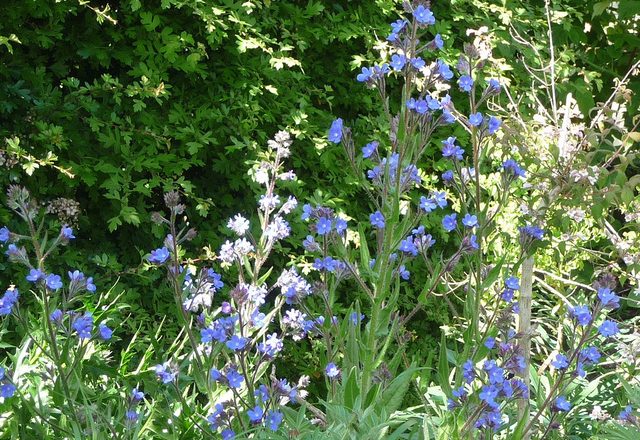
At the moment many members of the borage family are looking wonderful – we love their simplicity, the way they flourish – popping up everywhere and so easily – and we love the often bright blue borage flowers, which look wonderful in salads!
This is a family of around 2000 species, occurring mainly in Europe and Asia, especially in the Mediterranean region. Most of them are herbs, although there are some woody plants. Many are grown as ornamental plants, although some are a source of dye or have medicinal uses.
Take a look at some of the plants from this family in your garden and look at the characteristics.
Members of this plant family usually have:
- Blue flowers in a coiled inflorescence – the lower ones always opening first
- Stems and leaves covered in rough hairs
- Four seeds
There are many different cultivars and most of them seem to have blue or pink flowers. The most well known include Forget-Me-Not (Myosotis), Heliotrope (Heliotropium), the Comfreys (Symphytum), Borage (Borago), and Hound’s Tongue (Cynoglossum). Brunnera and the Anchusa are also in this family…
At the moment Anchusa ‘Loddon Royalist’ is looking fantastic – it is one of our favourites and is growing well in the garden. It is grown as a biennial so don’t forget to sow it in June or July to look good next year. The Garden House will soon have the seeds for sale.
Plant of the Month: Allium cristophii
Posted by editor on Friday, 13 May 2011
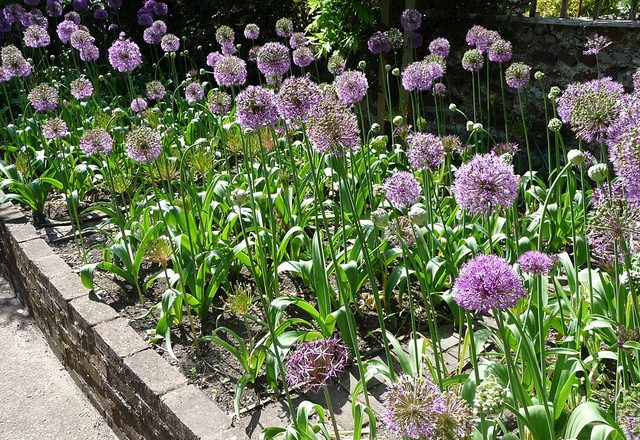
The Garden House currently has a stunning display of different kinds of ornamental onions – hundreds of blooms, and flowering around three weeks early!
Our mass plantings include: Allium ‘Mont Blanc’, A. hollandicum ‘Purple Sensation’ AGM, A. atropurpureum, A. nigrum, A. schubertii and our favourite – Allium cristophii.
- Common name – Star of Persia
- Family – Alliaceae
- Height & spread – 30-60cm (12-24in) x 15cm (6in)
- Form – Bulbous perennial
- Soil – Fertile and well-drained soil
- Aspect – Full sun
- Hardiness – Fully hardy, but may be tender when young
The name Allium comes from the ancient name for garlic, which is part of the genus. There are estimated to be around 700 species within the genus, and many cultivars.
Allium mainly come from dry and mountainous areas in the Northern Hemisphere, and have adapted to live in almost every plant habitat, from ice-cold tundra to burning, arid deserts.
There are perennials and biennials, ranging in height from 10cm (4in) to 150cm (5ft) or more – the taller species looking particularly good in groups in a border. After the leaves die back tiny pink-purple star shaped flowers appear clustered together at the top of the stalk, giving this Allium its characteristic ‘lollipop’ look, which in botany is called an umbel.
Typically they have upright to spreading linear-shaped leaves. The tubular based flowers are bell, star or cup-shaped and are borne in spherical umbels 1cm (3/8in) to 10cm (4in) across. Many take on a metallic colour in early summer.
In most species, a single bulb produces clusters of offset bulbs around it, which gradually form clumps. Many Allium give themselves away with the distinctive smell of onions when the bulb or foliage is bruised, and several species have culinary uses, including A. sativum (garlic), culinary onions, shallots and chives.
The Romans are sometimes held responsible for their wide distribution, while the whole group was valued by ancient civilisations as possessing medical and aphrodisiac qualities plus flavour.
Flower stalks dry well and can be used in arrangements or they can be left outside to provide frost-tinged winter interest.
Cultivation:
- Grow in fertile, well-drained soil in full sun
- Plant bulbs 5-10cm (2-4in) deep in autumn
- Plant clump-forming species with rhizomes at or just below the soil surface in spring
- Alliums are susceptible to white rot, downy mildew and onion fly.
Propagation:
- Propagate by offsets, removed when dormant, or by seed in spring at about 13°C (55°F)
- Keep moist and well ventilated, and dry progressively as foliage dies back
- Prick out and pot on when dormant. Seed grown plants, however, may not come true to the parent
- Alternatively, divide clumps of spring-flowering species in summer
The RHS Herbaceous Plant Committee awarded Allium cristophii an Award of Garden Merit (AGM).
Artists Open Houses, May 2011
Posted by editor on Saturday, 7 May 2011
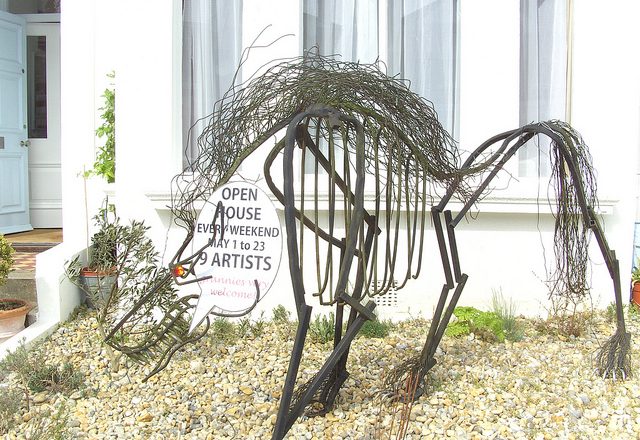
If you have the energy and time to spare, set aside the coming weekends to visit the wonderful Artists Open Houses 2011 – more than 1,000 artists are exhibiting their work at over 250 venues, spread across the city of Brighton and Hove and the surrounding area.
The event provides a great opportunity to view unique work in artists’ homes and studios and to buy directly from the artist or maker. The art and craft works are of every different type – paintings and prints, ceramics and metalwork, textiles and felt work, jewellery and silverwork – and sculpture.
Of course, our particular interest is in sculpture and art works for the garden, and there are many artists creating work for our outside spaces.
The 2011 Festival dates are May 7th and 8th, 14th and 15th, 21st and 22nd, and 28th and 29th.
The open houses are grouped into ‘trails’ – so select a trail, check the website for maps and directions – and get walking! For more info on trails and artists visit www.aoh.org.uk
Photos here show work by Jackie Jones (mosaic sundial), Terri Bell-Halliwell (stone sculpture) and Angie Evans (ceramic tile) among others.