Archive for September, 2011
Plant of the Month: Ceratostigma plumbaginoides
Posted by editor on Tuesday, 27 September 2011
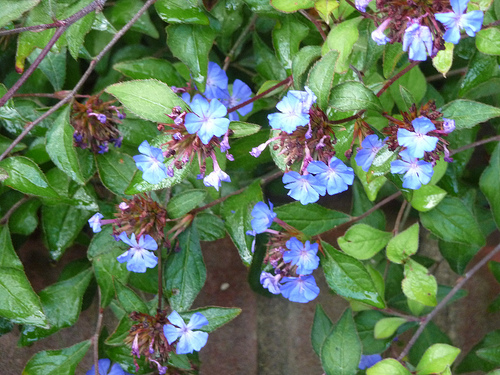
This delightful plant is a member of the Plumbaginaceae family and comes from comes from West Sichuan, in China. Its common name is hardy plumbago or blue-flowered leadwort.
It is a sub-shrub or herbaceous perennial with a clump forming habit putting on a fantastic burst of rich blue flowers from late summer. The foliage, which is green in spring and summer, turns to rich purple and red in autumn. It grows to about 30cms (1ft) high and has a spreading habit.
It deservedly has won the RHS Award of Garden Merit (AGM). This plant enjoys a south or east facing situation and needs shelter and grows in moist but well drained soil. It will tolerate most soils but does well on chalk. It looks good on banks and slopes, city or coastal gardens, cottage/informal gardens, flower borders and beds, Mediterranean climates or wall-side borders.
Cut back to ground level any shoots that get frost damaged, or you can cut the whole plant down in March if it hasn’t remained everygreen (depending on where you grow it) and it will shoot again ready to flower again next year.
This is a very useful plant for attracting late butterflies coming to feed, and humming-bird hawk moths are also efficient at extracting its nectar.
The plantsman E.A. Bowles suggests two possible ways in which C. plumbaginoides could have arrived here. The first is that a Mr Smith collected the seeds from the ruined ramparts of Shanghai; the second, which Bowles much prefers, is that seeds were plucked by a soldier as the British Army moved into Beijing.
Christopher Lloyd recommended growing it in dry-stone walls, where its colonising habit eventually results in a cascade of blue.
The Garden House is selling Ceratostigma plumbaginoides plants for £4.20 at our Friday Pop Up Garden Shop. We open every Friday afternoon between 3 and 6pm for tea and homemade cakes. Entrance is free – take a walk around the garden and buy one of our home-propagated plants! Location: The Garden House, 5 Warleigh Road, Brighton BN1 4NT
Pop up Garden Shop Fridays!
Posted by editor on Thursday, 22 September 2011
NEW! Starting Friday 23rd September, every Friday from 3-6pm we’ll be opening our garden gates and inviting you to enjoy our Pop Up Garden Shop!
We’ll be selling seasonal fruits and vegetables, a great selection of plants, seeds, preserves, eggs (from our own chickens!), mosaic gifts and other garden paraphernalia.
We have a large range of garden books and magazines in our cosy Garden Room – you are welcome to browse and enjoy a relaxing cup of tea and some delicious homemade cake – and of course ask all your gardening questions!
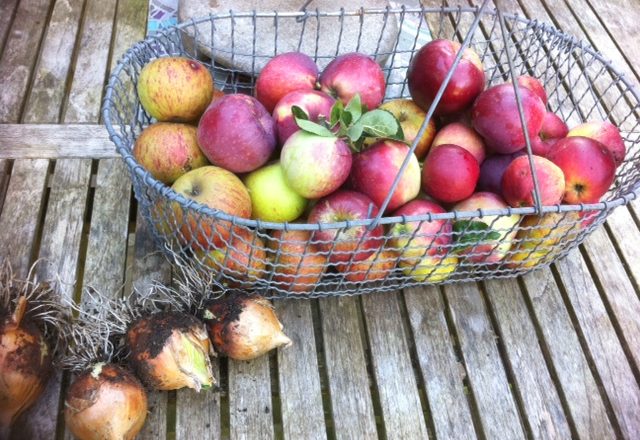
This week’s seasonal produce: apples (cooking and dessert) and pears all picked in our garden.
We look forward to seeing you!
Location: The Garden House, 5 Warleigh Road, Brighton BN1 4NT
Now’s the time to forage and preserve!
Posted by editor on Sunday, 18 September 2011
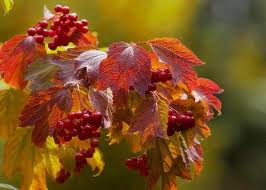
There is so much to be foraged in the hedgerows at the moment, including sloes, crab apples, haws, rowan berries, wild apples, plums and damsons and of course, black berries.
My favourite thing to do with my ‘forages’ is to make hedgerow jelly. You can use all of the fruits above and just chop them up, stalks and all (wash them first) – use more apples than anything else, about 50% crab apples or cooking apples and 50% of sloes, blackberries, haws, rosehips, rowan berries etc.
The crab apple, (Malus sylvestris) often found by the roadside is sometimes rather scabby but has a very high pectin content, (that’s the stuff that helps things set). Lots of the berries are low in pectin and so using this method will help it set well.
The reason I like to make jelly is that it’s so easy!
- You just boil up all the fruit, use 1kg of mixed berries and 1kg of crab apples.
- Then you can leave if over night to drip through a jelly bag or a piece of muslin and the next day add around 900g granulated sugar to the juice and slowly, (so you don’t burn it) bring to the boil, stirring until the sugar has dissolved.
- Then boil rapidly, without stirring, until setting point has reached, this should take about fifteen minutes. I put a saucer in the fridge and take out a teaspoonful of the jelly, put it on the saucer and if it wrinkles when pushed with your finger it is done.
You can also do this with blackberry and apples – it is absolutely lovely! A real autumn treat.
If you would like to discover the delights of how to make jams, chutneys and jellies then come along to our Preserving Workshop – on Friday 28th October – see our website for more details.
A favourite poem: Wormwood Jam by Tim Cresswell
Before the devil pisses on berries.
Late September Blackberrying down the
scrubs – by high high helixes of razor
wire. Filling peanut butter pots
with black red fruit. Brimful. Soursharp – Inky,
Imploding sweet – squashed by over- eager
Fingers – gashing hands on brambles that could
pull the wool from sheep. Gambling on low fruit
slashed by Shepherds and Rottweilers.
The kitchen filled with blackberry. Cauldrons
Of red black boiling glop. I tried to catch
the setting point – risking burns and blisters –
my fingers forming surface crinkles through
bloodthick syrup on a frozen saucer.
Entertain in our Garden Room!
Posted by editor on Wednesday, 14 September 2011
Looking for somewhere very special to celebrate Christmas or the New Year with colleagues, family and friends?
Our Garden Room is a unique space in a beautiful garden setting, ideal for relaxed and informal social gatherings.
We cater for lunches and suppers for groups. Delicious food freshly cooked using, where possible, produce from the garden or locally sourced ingredients. The Garden Room and tables beautifully decorated with foliage and berries from the garden.
Contact us to view our Festive Menus – £28 per person to include a welcome drink. Bring your own wine to accompany the meal.
We’re taking bookings now. Do get in touch and find out more!
Our favourite Apple Chutney
Posted by editor on Friday, 9 September 2011
With thanks to Garden House friend Chris Batt for giving us his recipe for Apple Chutney – a delicious way to use up your glut of autumn fruits, and to give away as gifts for Christmas…
Ingredients:
- 2lb onions, peeled and sliced
- 1 ¾ pints vinegar
- 1lb dates or sultanas
- 4lb apples, peeled, cored and sliced
- 1tbls ground ginger
- 1tbls ground cinnamon
- 1teaspoon cayenne pepper
- 1tbls salt
- 2lb sugar
Method:
- Place onions in pan with 2tbls vinegar. Cook gently until soft.
- Stone and chop, if used.
- Add the apples, dates or sultanas, the spices and half the remaining vinegar to the pan.
- Cook slowly, stirring occasionally, until soft.
- Add the salt, sugar and remaining vinegar, stir until sugar is dissolved and continue cooking until thick, stirring occasionally.
- Pour into warm, sterilized jars and seal. Makes about 5 ½ lb.
Variation:
Apple and Apricot Chutney: Use the same recipe as for Apple Chutney, but replace the dates or sultanas with 8oz dried apricots. Soak the apricots overnight in enough water to cover, and chop before adding to mixture.
Autumn, a favourite season…
Posted by editor on Sunday, 4 September 2011
The first signs of autumn are upon us. Somehow the air just smells different, and rain aside, September and October are just about my favourite months in the garden. Although there is much in flower (in fact a wonderful time of year for all those late flowering perennials), things are gradually closing down.
Having had a fairly lazy summer in the garden – my ‘to do’ list for the next few weeks is getting longer and longer…
The vegetable garden needs clearing of the almost finished runner beans, courgette and squash plants are tired and sprawling, the onions have been pulled and although this season’s tomatoes have been excellent I can see I’ll only have another week or so of cropping. We’ve eaten the plums and pears, made jars and jars of crab-apple jelly, and now the apple trees are weighed down with fruit and I’m trying to work out how to preserve them (luckily I’ve just found a Sarah Raven recipe for Apple & Mint Compote that looks delicious, so will get cooking tomorrow).
Seeds need to be collected, and seeds need to be sown. The flowerbeds are still colourful and abundant with big blowsy dahlias, neat little zinnias, verbena bonariensis, persicaria and many other late-flowering perennials. So we’ll have another few weeks of fresh flowers for the house, but then they’ll have to be cleared and dahlia tubers lifted (a real palaver, but the ones I left in the ground last year did not survive, so it has to be done).
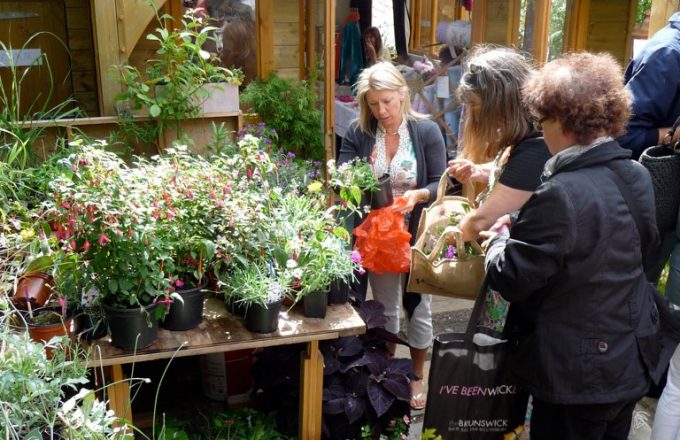
Earlier today at the Sussex Prairies Garden’s open day (rain, sun, wind, a typical approaching-autumn day!), temptation was all around. The various specialist nurseries all had great plants for sale – it’s so worthwhile seeking out specialist nurseries in your local area, their knowledge, helpfulness and beautifully raised young plants just make buying such a pleasure (even when there really, really is no room left in your garden!). So, even though there really, really is no room left in my garden (!), I bought three Agastache foeniculum ‘Golden Jubilee’, three stunning dark magenta Lobelia ‘tania’, a delightful Japanese Toad Lily (Tricyrtis formosana), a light mauve Physostegia virgina variegata, and some pretty white-flowered garlic chive plants (allium tuberosum) for the veg patch.
The Garden House stall caught everyone’s notice, with its display of herbs and preserves, mosaics by Sue Samways, and posters highlighting all the GH autumn workshops and courses, and the events for 2012 – including an evening talk with Fergus Garrett, a spring visit to Woolbeding Gardens at Midhurst, and a four-day trip to see Beth Chatto’s garden, the gardens at East Ruston Old Vicarage in Norfolk (inspiration at every turn!), and the truly wonderful Woottens of Wenhaston nursery!
Whilst at Sussex Prairies I also bought a beautiful old spade (a ladies border spade) restored to its almost original glory by Michael Ristic whose stall was a treasure-trove of pre-loved garden tools. It feels quite unique and nothing like the garden-centre variety. Hopefully it will also last a lot longer too (I managed to break two border forks this year!) and encourage me to get going, lifting and dividing!
And the spring bulb catalogues have arrived – another sign that autumn is definitely here. As always the catalogues look so tempting, and it’s sensible to try and do your planning and ordering sooner rather than later. I noticed that several of September’s garden magazines have inspirational photos of spring pots, showing varieties of narcissi and tulips mixed with various other bulbs, winter-flowering pansies and evergreens – useful if you’re feeling stuck for ideas and new combinations.
So…whilst enjoying the last of late summer, and contemplating an abundant autumn, I also find myself happily looking forward to next spring – what joy!