Archive for March, 2012

We love: Composting

Posted by editor on Saturday, 31 March 2012

If you want to garden organically, save money, and – so important right now – save water, think seriously about composting your garden and household waste.  Even in the smallest garden, using your own compost you can grow plants, fruit and vegetables without chemicals – and it’s free!

What you CAN compost:

  • Pet manure and bedding
  • Vegetable peelings
  • Uncooked kitchen scraps, eggshells and fruit skins
  • Dead flowers
  • Hedge and grass clippings
  • Coffee grounds and spent tea bags
  • Wood ash
  • Natural fibre fabrics
  • Nettles
  • Shredded paper and cardboard
  • Human hair

What you CANNOT compost:

  • Plastic bags, foam and plastic packaging
  • Medicines and chemicals
  • Spray cans, metal cans
  • Disposable nappies and synthetic fabrics
  • Glass bottles
  • Cooked food
  • Weeds
  •  Heavy root material, branches and some straw-like grasses may take just too long to compost so are best left out

WHERE to make compost:

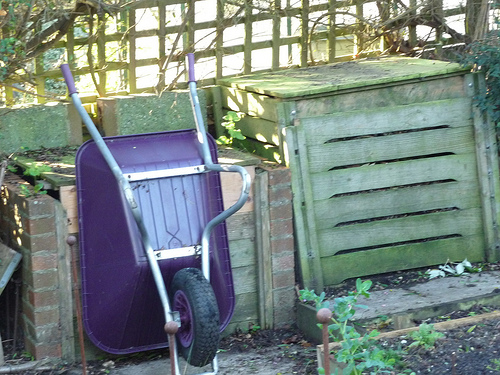
  • You can buy a huge variety of types and sizes of compost bin, you can even just build a heap and cover it over with some polythene or cardboard – however a bin of some sort is neater and easier to manage.
  • Site your bin in a sunny or semi-shaded position, and on bare earth or turf
  • It should be easily accessible (maybe positioned so that you can access with a wheel-barrow), and have a lid or cover

HOW to make compost:

  • Aim for a balance of materials, and aim to add to the bin in layers at regular intervals (every couple of days or so)
  • Keep the material damp, but not over wet or it may not produce a very pleasant end product
  • Turn occasionally – you may have a compost bin that turns on an axle, or use a special tool which you push into the compost, twist and pull out again, thus bringing the lower levels up to the surface – in this way you can also tell whether the lower layers have composted
  • If you have two or more bins, you can rotate – fill one bin then turn it into the next bin, then start filling the bin you have just emptied – and so on…

The best compost is loose, rich, dark brown and earthy smelling – this can take from as little as two months to a year depending on conditions and content.  It is ‘black gold’ and positively the best feed, mulch and soil conditioner you can create. 

Fergus Garrett at The Garden House

Posted by editor on Monday, 26 March 2012

A hugely inspiring and very relaxed talk by Fergus Garrett took place at the Garden House on the strangely warm evening of 23rd March. This was about as far as you could get from a formal talk followed by Q & A in a conference room or village hall. We began with a drink, while the palest of spring flowers around us in the garden lit up the dusk, then moved inside to share a gorgeous meal as Fergus talked and showed slides of plants, plants, and yet more plants!

Many of the photos were taken at Great Dixter, where Fergus is director, having taken on the mantle of Christopher Lloyd after his death in 2006. Others were of striking plant associations and gardens from all over the world. Some were of the same small areas as the seasons progressed, showing how forms and colours changed as clever successive planting moved on with a mix of annual bedding and perennial framework. The bleached and frosted colours of late autumn and winter were particularly impressive. This style of gardening needs good planning and intensive input, but Fergus was keen to show the experimental side of Great Dixter, the importance of observing, reviewing and changing things in a garden to keep it fresh, in the spirit of its idiosyncratic creator, but not preserved in aspic. 

We were surprised to discover that Fergus was originally a local boy, and once worked for Brighton Parks Department before moving on and up, through National Trust gardens and the South of France, before being head-(gardener)-hunted by Christo. Both shared a love of bold colours, which Fergus jokingly put down to his early Parks experience. We were treated to a shot of a pile of Christo’s shriekingly colourful polo shirts, and heard that he yearned for a black-and-yellow wasp-striped number. We also learned of his love of tucking new plants into odd corners and crevices to “see how they did”; and the important role of self-seeders in the garden at Dixter, letting things place themselves and fight it out, and culling if necessary. All this was very heartening to hear.

Fergus is supremely knowledgeable and without hesitation reeled off the names of numerous plants, many of which were new to me, though often species cousins of more familiar garden plants. I scribbled notes in the semi-darkness and was amazed to find them readable next day. Well, sort of. Some of his favourite plants included: the architectural Ferula communis (a giant fennel that does not seed around like its relative foeniculum), Miscanthus ‘Cosmopolitan’, Echium rusicum,  Agave attenuata (swan-necked agave), and loose-formed plants which thread their way through others, such as Erigeron annuus, Ammi visnaga, Tagetes patula ‘Cinnabar’, and Campanula patula. Not forgetting the little daisy which is everywhere at Great Dixter, Erigeron karvinskianus.

We came away impressed by the enthusiasm and energy of a very famous gardener, and in such a friendly and intimate setting – altogether an unforgettable evening.

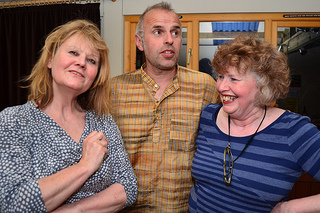
Words: Julia Widdows; photo of Deborah, Fergus and Bridgette: Dulcie Lee

Decorative stained glass workshop…

Posted by editor on Monday, 19 March 2012

As you walk through your garden, something sparkles and catches your eye.  How wonderful if it is an artwork you have made yourself…

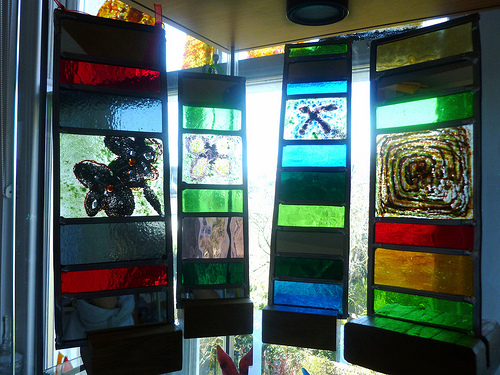
Last Saturday’s stained glass workshop led by Annie McMullan offered just that, a thoroughly enjoyable day learning a new craft and taking the resulting stained glass decorative panel home: “This is going to hang in my garden where it will catch the light.  I can’t believe I achieved this all in one day!”

Fused glass ‘flower pictures’ were made in advance by Annie – the students selected one of these then picked out complementing colours of stained glass to go with it, and under Annie’s experienced eye they then cut the lead and soldered the panel together.

Annie said: “What a fantastic and enthusiastic group of women, they all learnt the skills really fast.  Although initially a bit uncertain about cutting glass they soon overcame their fears and were cutting with great skill!

Some particularly loved the leadwork part of the workshop where you cut the lead to hold the glass into place, while others did very well using the soldering iron.

By the end of the day everyone had produced a beautiful piece of stained glass. I think everyone should all be very proud of their achievements.  The day was a real mixture of creativity, concentration and fun.”

Wonderful, another successful Garden House event!  Check out Annie’s website www.anniemcmullan.co.uk

Growing Perennial Vegetables

Posted by editor on Wednesday, 14 March 2012

Something to think about at this time of year is making a perennial vegetable bed; that means vegetables that will continue to grow year after year.  Some examples are asparagus, globe artichokes, Jerusalem artichokes, sea kale, cardoon, chicory and varieties of broccoli, and onion.  Check out the internet or nursery/garden centre for crops available as ready grown plants or we like to grow plants from seed – that way you get a better choice and some more unusual varieties.

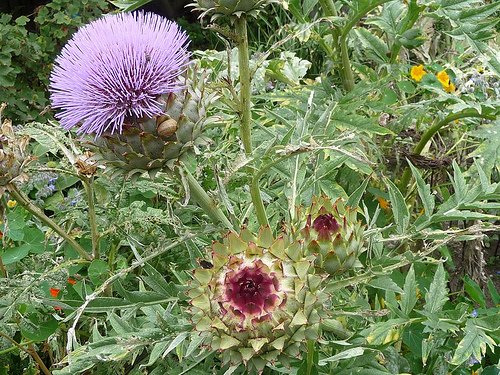
Globe artichokes – fantastic plants that give great architectural value with their silver, jagged edged leaves, and also give you edible flowers.  The artichoke is a really stunning plant – at The Garden House we use it as our logo and sell the seeds too.  It is easy to grow from seed, it should then be planted in well-drained soil in the sunniest possible site as they are slightly frost tender.  You may need to cover them with fleece during severe weather.  It is possible to propagate them now so if you have a friend with an established plant ask them if you could have a cutting.  All you need to do is to take a side shoot from the parent plant, use a knife and remove a side shoot far down as possible – preferably with a piece of root attached.  Pot up your cutting and water it well and keep it well watered until it has settled down, cut down the leaves if they are really long, to about half to reduce water loss. The variety we like at the Garden House is Violetta de Chioggia - it produces fantastic heads to eat or to just enjoy in the border and is great for bees.

Cardoons – similar to artichokes, but they are grown for their edible leaf stalks not their flower heads.  They are the wild parent of the artichoke and were very popular in the Victorian era.  Cardoon plants can reach up to 2m (6½ft) and is usually grown as an ornamental.  They must be picked when young, before spines develop.  They require blanching, like celery, this means gathering all their leaves together and excluding light with black plastic or cardboard in later summer for two or three weeks.  The midribs can then be steamed or boiled.

Asparagus – a real favourite and there are many wonderful varieties to try. ‘Gijnlim’ have masses of thin spears and have got a really good flavour, and  ‘Violetto d’ Albenga’ is an Italian variety and has lovely purple spears. If you have prepared a bed for your asparagus now is a good time to plant them.  Asparagus is expensive to buy in the shops but it is easy to grow and tastes delicious when freshly harvested.  Once established, twelve plants will produce an average crop of 10kg (22lb) annually for twelve year or more.  Try to buy one-year old crowns as these will establish quicker.  Space the plants 38cm (15”) apart in row 1m (3ft) apart.

Chicory – can be treated as a perennial and the bitter leaves can be gathered early or late in the season, after any hearting rosette has been cut.  It can grow to about 60cm (2ft).

Jerusalem artichokes – grow to 9ft and make a really good wind break; related to sunflower they are covered in bright yellow flowers.  You can make delicious soup or roast their fat, knobbly tubers. To grow, plant the tubers 15cm (6”) deep and 30cm (12”) apart.  Draw up the soil around the bottom half of the stems when they are 30cm (12”) tall to give them some support.   In mid-summer cut most stems – leave a few so you can enjoy their flowers – back to about 5ft.  Prune the plants to leave 8cm (3”) stumps above the ground when the foliage starts to turn yellow later in the year.  You can harvest them between autumn and late winter.

Perennial onions – try something a bit different.  The tree onion forms clumps of edible bulbs at the ends of the flowering stems that can be used like shallots, They also make offsets around the base of the plants which you can use instead of spring onions.  Welsh onions are lovely and look a bit like chives but they can be pulled from the ground to use in salads.

Sea kale – we think that sea kale looks lovely, especially growing in a seaside city. It is an old Victorian vegetable and is hard to get hold of but you can grow it from seed. It appears in late winter when few other fresh vegetables are ready – this is because it is traditionally forced, like cardoon and rhubarb. It is another easy plant to grow from seed (it is illegal to harvest it from the wild).

Many of the perennial vegetables can be found at Delftland Nurseries, organicplants.co.uk or Victoriana Nursery Gardens victoriananursery.co.uk.  You could also try the Real Seed Catalogue, realseeds.co.uk if you are looking for some unusual tubers to grow, and of course we have seeds at the Garden House.

Time to organise your veg beds!

Posted by editor on Friday, 9 March 2012

March is here and it’s time to get organised in your vegetable plot…

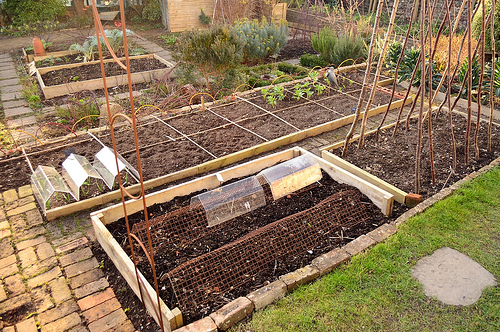
  • Check, repair or replace any rotten raised-bed boards, and build new compost bins.  Clean, sharpen and oil secateurs, loppers and shears.
  • Set up more water butts – you may need them this year!
  • Chit early-maturing potatoes such as Charlotte, Vivaldi, Red Duke of York, Maris Bard and Accord – egg boxes make good chitting trays, put the tubers with the ‘eyes’ facing upwards.
  • When chitted (sprouted) you can carefully plant your early potatoes under cover in special vegetable bags, or even use an old compost bag.
  • Plant out individual garlic cloves 10cm apart in prepared ground and cover with cloches or fleece.
  • Plant onion sets in modular trays of compost, keep under cover to plant out later.
  • Last chance to plant out bare-rooted fruit trees and summer fruiting raspberries.
  • Plant out cold-stored strawberry runners, sowing seeds of alpine varieties or even pollinate strawberry flowers under glass.
  • Sow in trays and modules in the greenhouse (for growing on in the greenhouse): tomatoes, aubergines, peppers and cucumbers.
  • Start sowing hardy veg outside or under cloches: carrots, beetroot, broad beans, salad onions, cauliflower, cabbage, spinach, leeks, lettuce, rocket, coriander, mixed salad or stir fry leaves, radish, turnip, peas, lettuce and Swiss chard.  Don’t sow too many at once, leave some space for a second sowing to extend your season.
  • For early veg, grow some of the hardy veg under cover in your greenhouse beds: radish, rocket, lettuce and salad leaves.
  • Fork over your beds, clearing any weeds (don’t throw into compost bin!) – you could also warm your bare soil by covering with a sheet of polythene and pinning it down, just for a week or two before planting commences.
  • Get your hazel or bamboo bean-pole structures in place – make sure they’re pushed well into the ground as they’ll be bearing a lot of weight once your beans start growing.
  • It’s not too late to dig a compost trench for your runner beans. Dig a trench to about a spades depth, then fill with kitchen peelings and vegetable waste, rotten apples etc, also a bit of torn up old egg boxes or cardboard. Cover with soil to stop foxes scavenging.  Leave to compost down until you plant your beans, around mid-May.
  • While your beans and pea beds shouldn’t need any more feeding for now, you could enrich the other beds with garden well-rotted compost, manure or an organic fertilizer.

Hardy and Half-hardy Annuals – When to Sow

Posted by editor on Sunday, 4 March 2012

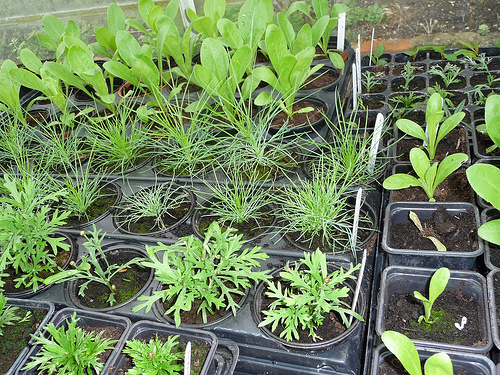
Hardy Annuals – are plants with a life cycle of one year that will tolerate the frost and can be sown without heat and will be fine to leave outside, though preferably with some shelter.  Examples of these would be Nigella and Cornflowers. You can sow them in September/October or from now until end March. Some, such as sweet peas, are best grown in modules to avoid root disturbance.  Most make great cut flowers.

Some vegetables have hardy varieties that are fine to leave outside in the cold weather – I have just picked some salad leaves, mizuna, mibuna, giant red mustard and pak choi that have been growing in the veg plot quite happily, unprotected, during all this cold weather.  You can also get hardy broad beans, such as Aqua Dulce Claudia, and onion sets that will be fine outside during the winter.

There are also some lettuce varieties that do well outside. The following all survive in Brighton (if you live somewhere cooler and wetter, try these in pots or window boxes sheltered against your shed or grown in a greenhouse if you have one). Try ‘Green Oak Leaf’ – if you pick it carefully, just harvesting a few outside leaves at a time, you should be able to pick from six to eight weeks from sowing, right through the winter. Then, as spring begins, it really pushes out a ton of leaves from early March until at least the end of April. The same applies to the red-coloured ‘Cocarde’ which being red also keeps off the slugs and snails – for some reason they don’t seem to be attracted to red veg! The American variety, ‘Black Seeded Simpson’, is a surprisingly hardy variety with a lovely texture and taste, and the famously winter-hardy lettuce ‘Valdor’ is soft, rounded, and delicious.

These should keep you in salads through the winter.

Half-hardy Annuals – are plants that will not tolerate the frost and need heat to germinate (around 20ºc).  Their life cycle, at least in our climate and like the hardy annuals, is one year from germination to dying. These include veg plants such as tomatoes, chillies, aubergines, peppers, runner beans, courgettes, sweet corn, and many of the brassicas – cabbage, Brussels sprouts, broccoli.  There are also many half-hardy  flowers, often used in containers or bedding such as Petunias, Impatiens, Lobelia.

With half-hardy annuals the important thing is timing – some plants, for example chillies and Petunias, need a really long growing season and so, if you have a propagator, it is a good idea to sow them now.  This will allow plenty of time for them to mature and you will be more likely to get good fruiting and flowering in the summer as they will have had maximum time to receive as much light and heat as possible.

Other plants, such as Cosmos, nasturtiums, sunflowers, sweet corn and courgettes, germinate and grow quickly, as do runner beans so leave these and sow them later on in March or April.  They won’t be safe to plant outside until danger of frost has passed, around mid May in this part of the country, and so if you sow them too soon you will have a kitchen full of sprouting runner beans with nowhere to put them!  The chillies and aubergines and other slow growing things, that you are sowing now will need to be kept somewhere frost free until mid May to – so bear that in mind and don’t sow too many seeds!

As with so much in the garden, planning is vitally important – be realistic about what you can manage – allowing for a few failures and some to give away.

At the Garden House we have seeds of many of the above for sale, so do contact us if you would like to purchase some.

We also have a workshop on Growing Your Own Cut Flowers on Saturday 21 April so do come along and learn how to make your own cutting garden.